Wednesday, November 20, 2013

Oliver Stone's 'JFK': The Truth Will Set You Free


As the 50th anniversary of the assassination of John F. Kennedy approaches, a Gallup poll found 61 percent of the American public believes someone besides Lee Harvey Oswald was involved in the killing of the president. This is the lowest number in decades, as the percentage was some 20 percent higher more than a decade ago. That shrinking number perhaps represents a kind of victory, considering it is in the era of the Internet, a veritable incubator for amateur historians and speculative theorists. Or it could be reflective of a number of issues – the natural skepticism of the public toward government and the media, the fading memory of an America largely born after the event, or the succession of 9/11 as the prime touchstone for conspiracy theories of this age. 

But 20 years ago, speculation on the Kennedy assassination reached a fever pitch in the popular culture with the release of what many consider Oliver Stone’s greatest movie, “JFK.” It inspired a generation of media devoted to the idea that the American government was involved simultaneously in vast enterprises of skullduggery and equally vast enterprises to cover up those same activities. The truth or falsity of the film’s content is not the point – “JFK” is worth watching even now simply because it is an excellent film, managing to entertain even as it tries to persuade. It has been called everything from treasonous to fantastical, but it endures after repeated viewings, not only for what it says, but how it says it. 

“JFK” begins with a prologue – Eisenhower’s farewell address, which introduced “the military-industrial complex” into the American lexicon. That is immediately followed by a brief recounting of the Kennedy Administration, narrated by Hollywood’s faux-Kennedy, Martin Sheen. The parade of stock footage, news reel and television images recount the Bay of Pigs, the Cuban Missile Crisis, and the beginnings of the Vietnam conflict. These images cast Kennedy as a glamorous, young, vital leader who was slowly moving toward peace and away from conflict. 

By the time we get to November 1963 and Dallas, Stone intercuts with a woman warning of the assassination in a hospital, along with a man suffering an epileptic seizure just prior to Kennedy’s arrival in the motorcade. These are moments filmed for the movie, but they are cut among the authentic past footage in such a way that we don’t notice it at first. The drums, the music, prepare us for the moment we know is about to arrive – yet we do not see it. The screen goes blank, we hear a gunshot, and then the immediate aftermath. This is a crucial decision. Stone has wisely understood that the story he is telling is a mystery, and it should be dramatized as such. Without showing anything, he has, in effect, wiped the slate clean of what we think may have happened in Dallas.

We then meet the New Orleans District Attorney Jim Garrison, played by Kevin Costner, sitting in his office, unaware of what is happening in Texas until one of his deputies comes in to inform him. From this moment, Stone does what William Manchester’s “The Death of a President” did – it puts the viewer in the skin of someone who lived through Nov. 22, 1963. Garrison goes to a bar to watch television coverage, and learns along with a room full of strangers – his countrymen – that the president is dead. Tears follow, but so do cheers. “God, I’m ashamed to be an American today,” Garrison says, summing up the disgust felt by many -not only Kennedy’s admirers but those who were shocked that the President could be murdered. 

But the images do not stop on the television. Eyewitness accounts from Dealey Plaza vary as to where the shots came from – the Texas School Book Depository, or the picket fence above the grassy knoll? The bar learns of Oswald’s arrest for J.D. Tippit’s murder and we see Oswald dragged from the Texas Theatre. Is it just me, or does the first appearance seek to make Oswald look sympathetic? We hear him audibly scream with pain when shoved into a police car, and we see him “emphatically deny” any charges. When Garrison learns that Oswald spent the summer in New Orleans, he begins to track the man’s movements and comes into contact with David Ferrie (Joe Pesci). As JFK’s funeral – and the shooting of Oswald play out in the background – the feeling is spooky. There is the nagging sense that something else is going on that can’t quite be pinned down – which is what anyone who experienced those four days felt. 

A conspiracy theory – indeed, any theory – is concerned with obtaining truth. But the conspiracy theory is special in that it proclaims itself as a truth distinct from a more widespread or accepted set of facts. It usually concerns itself with “the real” reasons behind specific events, or the “real” perpetrators. It gives its believers a certain standing, in that they are the only ones who “know what really happened.” They see events as they truly are, not like the rest of the world which has accepted a lie. There is something much like religion going on emotionally with the people who accept the theory – the “true” believers. To themselves, they perceive reality at a higher, more authentic level. And in the case of the Kennedy assassination, it also gives the believers a task, a quest to resolve the crime and find the person or persons responsible. My aim in stating this is not to dismiss conspiracy theorists, but it must be understood that people are oftentimes emotionally invested in the facts they embrace, as well as the facts they choose to shun. As Manchester observed, there is an emotional reason to believe that someone besides “the wretched waif Oswald” killed Kennedy. And because Oliver Stone is working in film, he understands the emotional needs of his audience. 

With the appearance of Ferrie, we see Stone’s gifts as a filmmaker. As Garrison questions him, Ferrie begins to descend into obvious fabrication. How do we know it’s fabrication? Because even as Ferrie spins his stories, we see short bursts of film, intercut into the scene with sound effects to undermine his words. By the time Garrison informs him he is being held for further questioning - because his story is “simply not believable,” we laugh at Ferrie’s response: “Really? What part?” Stone has managed, in just a few minutes, to make us laugh and reinforce his core message – that no one can be trusted to know, or tell, the truth about the murder. It is that nagging sense of something wrong  that is the reason that “JFK” is, as it was billed on release in 1991, “the story that won’t go away.” It is also why Garrison, after wading through the 26 volumes of the Warren Commission Report, takes up an investigation into the case years after the fact.

Stone’s intercut images also establish a pattern – as the movie unfolds, we will see recreations of events in the lives of Oswald, Ruby, Ferrie, and others, as well as the assassination recounted – though never totally until the end. Through the use of black and white footage, aged color footage to resemble home movies, and other different stock photography, we are being enticed into the illusion that we are seeing these things as they really happened. This is helped along by the familiar faces we see in cameo – Walter Matthau, Jack Lemmon, Ed Asner, Gary Oldman, Tommy Lee Jones, John Candy, Kevin Bacon and others.

But the other gift Stone displays is the ability to throw an unreal amount of information at the viewer and still keep the story moving and the characters interesting without any confusion. Consider – during the course of “JFK,” we are introduced to several conspiracy theories involving Oswald, Ruby, Ferrie, Guy Bannister, Clay Shaw, the CIA, the Mafia and the military, and we are also enticed to follow the career of Jim Garrison and his staff. Yet over the course of three hours, the story never bogs down in the minutiae of the theories because the pace never slackens. The movie is briskly edited, and Stone’s script manages to pass along his “facts” in only a few seconds. If there is confusion, it plays into the movie’s central thesis of conflicting narratives, shadowy motives and unsure information – “We are through the looking glass here, people. White is black, and black is white.” 

For example, take the character of Lee Harvey Oswald. For much of the movie, Oswald is a chess piece. We see him in the homosexual underworld of New Orleans, passing out pro-Castro leaflets, haunting the anti-Communist Bannister’s office and Jack Ruby’s night club, defecting to the Soviet Union, living alone, associating with others, loving and beating his wife, holding his baby (with Garrison smiling as he considers it), acting as both hero and villain. We see his face superimposed into a created photograph as Garrison spins a theory that Oswald was an intelligence agent, possibly framed with Kennedy’s death. Stone even filmed a scene that was later cut from Garrison’s courtroom summation where the “ghost” of Oswald testifies to his innocence. There is no attempt to reconcile these conflicting Oswalds, because they match up with the words of David Ferrie – “Everybody’s flippin’ sides all the time. It’s fun ‘n’ games, man! Fun ‘ n’ games! …There’s more to this than you can dream!”

Even as the story goes forward, and Garrison makes a pilgrimage to Dealey Plaza, we are confronted with the eyewitnesses to the assassination, but not the event itself. Stone does not tell us that Jean Hill’s story has changed many times after 1963, or that her timeline of questioning can’t be based in reality. He shows us Garrison flinching at the picket fence on the Knoll, and the running figure of Jack Ruby through the Plaza. We still do not see the moment of the killing, except in bursts of a second or two. We are not yet true believers. The genius of the movie is that it slowly nudges us in that direction. 
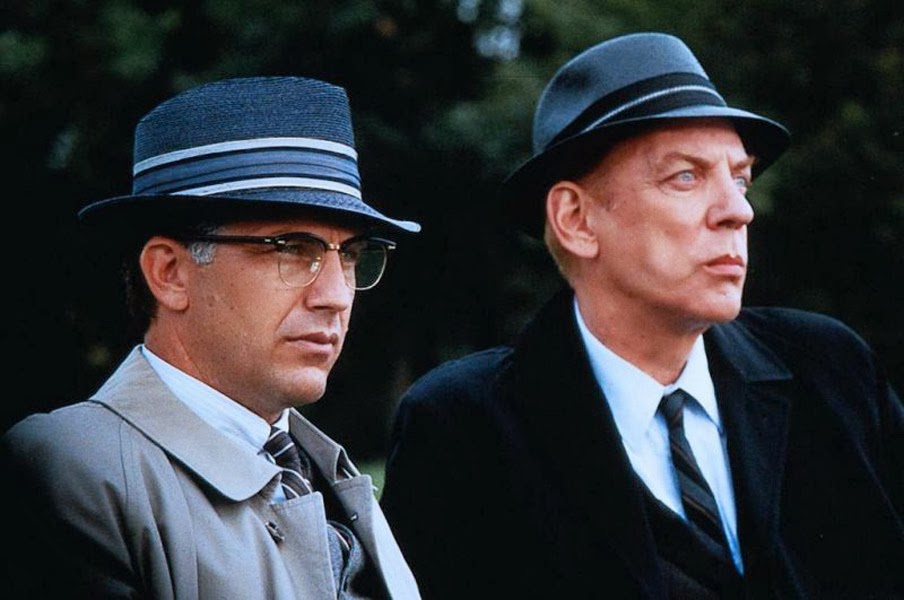
It is after the death of David Ferrie that Garrison travels to Washington, and Stone introduces us to the character of X, played by Donald Sutherland. X is the witness – the voice from the abyss who tells the audience that their suspicions are not crazy. X gives the Cold War background of the CIA – “We were good. Very good.”  Then as things begin to go badly, with the implication that some dark shadow has descended on American ideals, he recounts how Kennedy was beginning to withdraw troops tentatively from Vietnam. 

This is the sermon portion of the movie – where we are reintroduced to the idea from the opening – that the military-industrial complex has too much power in the United States and has warped the soul of the country, as best depicted in the nation’s entanglement in Vietnam. In many ways, “JFK” is the movie that sums up the Baby Boomer generation – there is an optimism in the idea of America, but the abiding belief that its greatness is an illusion perpetuated by sleeping believers and propped up by evil, ruthless men who will kill to preserve their power. There is no attempt to explain why a conspiracy exists to continue a war in Vietnam except greed in selling weapons, and the presumed endless need of the military to seek out an enemy who must be destroyed. In the years since “JFK,” one might legitimately ask why similar assassinations did not happen when bases were closed and the military was downsized following the end of the Cold War. But by the time X is finished, we want to believe in something terrible hatching in a smoke-filled room amongst dimly-lit generals and bureaucrats, something “as old as the Crucifixion.” 

Garrison leaves Washington, after a pilgrimage to Kennedy’s grave at Arlington, and we are not surprised when he is ridiculed and followed, lampooned and potentially set up because we feel he is close to the truth, whatever that truth may be. When a fatigued Garrison argues with his wife over news coverage of Martin Luther King’s assassination, or wakes her to tell her that Bobby Kennedy is dead, we are not surprised. It only reaffirms what we have already been told – the other side will stop at nothing. 

By all accounts, Garrison’s trial against Clay Shaw was a joke. But Stone isn’t documenting that trial as much as he is putting the Warren Commission’s theory of the Kennedy Assassination on trial. It’s during the courtroom scenes that he finally reveals the moment of the shooting – his theory of the case. He begins by showing the Zapruder film, which at that time still had not been widely seen. Using the actual footage, Stone then recreates his version of the shooting. Oswald is never seen – but instead Stone and Garrison theorize three teams with a triangulation of fire. To do that, they have to take apart the “Magic Bullet” theory. What’s interesting is that Stone does not use a recreation shot for this, but a courtroom approximation – an approximation which does not account for the presidential limousine’s jump seats or the angles at which Kennedy and Connally were seated. To do so would have undermined his theory. Instead, it allows him to pick apart the Warren Commission findings as invented. When it comes time to present his own theory, we finally see a recreation – which makes it “real” for us. 

The “reality” comes when we are taken to Parkland Hospital to see the emergency room treating Kennedy, followed by a recreation of the Kennedy autopsy, which feels uncomfortably authentic. When we hear a general say that he’s in charge, we are ready for Stone to reveal to us what really happened. We don’t laugh when Garrison says, “Let’s just for a moment speculate, shall we?” despite the fact that speculation is precisely what we have been doing for the last two hours. We see fake Dallas Policemen on the knoll, men in “Acme” suits in the sixth floor, and men with rifles in another building. (It’s interesting that the rifle teams are racially diverse, by the way.) Then Garrison replays the Zapruder film to recreate the motorcade, only this time superimposing his own narration, intercut with recreated shots. When he repeats that Kennedy’s head goes “back, and to the left,” we are being invited to believe this because it is crucial that we believe the shot came from the knoll. A shot from the front means a conspiracy. (The official explanation is that Kennedy’s head snaps back because of the force of the bullet striking his head from the rear right, causing a whiplash effect.) 

But the motorcade is not the end of the story, because Stone must now account for Oswald. His actions immediately after the shooting are recreated, including the murder of Tippit. But he also recreates competing theories, sowing enough doubt about his guilt here (and there is more than enough guilt linking Oswald to this crime) that when we again see Oswald carried from the Texas Theatre, we might just believe he is a sympathetic figure, framed for the crime so the real gunmen will safely get away. Mournful music plays once Ruby shoots him, and Stone gives us close ups on the seemingly unfazed faces of Dallas policemen, cigarettes dangling from their lips, who seal his doom. 

Despite all of Garrison’s eloquence, we know his case will fail. But we don’t care by this time, because by now, we know the truth. Though Stone’s movie was meant to inspire people to look for their own answers, what it instead inspires is a false sense of information, a sense that we have suddenly been given access to privileged facts, and that, in knowing the truth, we have now been set free. 


Set Your Fields on Fire

The award-winning novel by William Thornton
Available now

Some of the coverage of "Set Your Fields on Fire"

 You can order "Set Your Fields on Fire"for $14.99 through Amazon here.
It's also available on Kindle at $3.99 through Amazon here.
Read an interview I did with AL.com on the book here.   
Here's my appearance on the Charisma Network's CPOP Podcast. 
Here's an interview I did with The Anniston Star on the book. 
Shattered Magazine wrote a story about the book here. 
The Alabama Baptist wrote about the book here.
This piece appeared in the Marietta (Ga.) Daily Journal.
Here's the write-up from The Birmingham Times.
Read a story for Village Living here.
This story appeared in The Trussville Tribune and this video.
Here's my appearance on East Alabama Today.
Story and video from WBRC Fox6 here. 
Here's the write-up in The Gadsden Times on the book.
Read a piece I wrote for WestBow Press about writing the book here.
A piece about some inspiring works for me.
This is another interview with the fleegan book blog here. 
Read a piece I did for WestBow Press about writing the book here.
Read another interview with the fleegan book blog here. 

Friday, September 27, 2013

Whatever Happened to Miley Cyrus?


It hardly seems timely to write anything about Miley Cyrus’ performance at last month’s MTV Video Music Awards. The former child star, as she has done for the past three years, put together an exhibition designed primarily to wipe away the image that remains of her in the public as television’s “Hannah Montana.” Her appearance, such as it was -tongue wagging before a live audience, barely dressed in a flesh-colored  costume, dancing with large stuffed animals – was tiresomely familiar to anyone with their eye on popular culture. After so long performing, her music might actually be more honest now while at the same time being more artificial. 

But Cyrus is by no means unique, which is one of the reasons that even her MTV performance had a relatively short shelf life in the storehouse of pop outrages. Both the Disney Channel and Nickelodeon have spent the better part of a decade fashioning child stars and disposing of them. These stars – usually female, possessing some vocal talent and in the netherworld between child and teenager – usually figure prominently in television shows with a protagonist on the edge of “stardom.” Then they and their zany friends have relatively wholesome adventures, sing a few songs, and prepare themselves and their audience for the pressures of impending adolescence. For every Miley, there’s Selena Gomez, and iCarly, and Demi Lovato, and the Olson twins, and Amanda Bynes, and so on. Each one is packaged in a similar fashion, making their identities blur and their careers follow a familiar, depressing arc of stardom, fascination, decline and floundering before …

I was reminded of this watching “Whatever Happened to Baby Jane?” A 50-year-old movie starring Joan Crawford and Bette Davis, “Baby Jane” is a fun-house grotesque;  a meditation on the corroding influence of fame, stardom, abandonment, and role-playing. It’s the sort of movie that Hollywood does best when it wants to talk about how terrible a place Hollywood can be. (They would know, wouldn’t they?) It also offers a window into how terrible a place the world can be when we rely on false images to save us from ourselves, and how little consolation we can find within. 

“Baby Jane” opens in the golden age of vaudeville in 1917, with the sound of a crying child. Inside a theater, a crowd is watching “Baby” Jane Hudson, a sweet, blonde child on a stage dancing and singing. The audience can buy an exact replica doll in the lobby to take home for their very own. Baby Jane sings her trademark song, “I’ve Written a Letter to Daddy” – a Victorian-era weeper about a child writing a love letter to her dead father. But Baby Jane’s father is at that moment alive, and we see that he is more or less managing her career. We are not surprised later to find that for all her talent, Baby Jane is a spoiled little girl. When she stages a tantrum after the show, a crowd of mothers and children waiting for her autograph are also quick to pass judgment on her and her parents.
Nor is she alone in the world – she has an older sister named Blanche, and a mother. Mother makes her only appearance at the beginning, when she tells the older sister that she’s “the lucky one” – presumably because she isn’t on stage. “I want you to be nicer to Jane and your father than they are to you,” she admonishes her. Implicit in the command is both the idea that Jane will need someone in the future, and that the mother won’t be there.  Lurking in the background is the idea that Blanche is luckier because she isn’t the one on stage. 

Then the scene shifts ahead to 1935, and we are aware that the roles have reversed. Blanche Hudson is now an accomplished, sought-after Hollywood actress. She has also taken her mother’s advice, because we learn from two studio hacks that Blanche is “taking care” of Jane – making sure she has roles, in spite of her lack of acting talent. But she’s “not doing Baby Jane any favors” by doing so, one man says, before asking the question, seemingly aimed at a large automobile – “Who do they make monsters like this for?” 

Is Baby Jane a monster, or is Blanche? We think we know the answer when we see two anonymous figures – one standing at a gate, another behind the wheel of a car, and we are led to believe that one has run over the other on purpose. We know Jane is a drinker now, and we feel that these two sisters will always be at each other’s throats. So we aren’t surprised later to find what has happened – the two sisters are, years later, unmarried and living in a forgotten Hollywood mansion. Blanche is crippled physically, unable to walk and confined to a wheelchair. Jane is crippled emotionally, still comically resembling the old child star, bitter and broken. Though it is the present, the title card tells us that this is “Yesterday.” 

“Whatever Happened to Baby Jane?” is a question familiar to us. We learn of and discover media personalities, and then lose track of them. What happened to them? Why aren’t they still “around?” Did he or she die and I didn’t notice? The obvious answer is “Baby” Jane grew up. But why don’t I know what happened? How could someone with that much talent at an early age not go on to do something even bigger? The answer is understandable. A child prodigy may be a figure of immense talent who is capable of greater accomplishments as they age – one thinks of Mozart – or a gifted youngster who masters a very narrow skill at an exceptionally early age but is unable to progress beyond this. That is why being a child prodigy can be a blessing – unlimited wealth and attention that makes one “set for life,” or an impossible standard of achievement that one is burdened with for the remainder of his life. Normal people live under the sometimes mistaken impression that the best is yet to come. But what if it’s already happened? What then? What if you’re never allowed to grow up? 

One of the draws of “Whatever Happened to Baby Jane?” is its two real-life stars, famously dismissive of each other but both needing a hit to restore their careers in 1962. Joan Crawford will probably always suffer under the burden of “Mommie Dearest,” which makes her performance as the seemingly good-hearted Blanche that much more interesting. Bette Davis does her best to make us loathe the self-loathing Baby Jane, so that we laugh at her while at the same time being revolted as she serves up rats and parakeets for her sister’s meals.  Jane is still performing – as Blanche, by copying her voice over the phone and forging checks. Even then, she is nowhere near as gifted or as shrewd a performer as her sister. 

Something else is going on in a movie that is obsessed with performances. Even in private, the lives of these two women are, at best, illusions. Jane has a veneer of bitterness and brass that inadequately conceals her vulnerability and insanity. One of the unintended legacies of this movie is its appeal to camp, and that is partly because of Davis and Crawford and their careers built on strong, independent women through over-the-top performances. 

Baby Jane has not grown up, but she is Blanche’s caregiver. And even though she resents the role, there is a theatricality about it. In real life, for example, it would be ludicrous for Blanche to live on the second story of a house when she is stuck in a wheelchair. (Of course, she’s up there so Jane can presumably control her.) But by Blanche’s being above and set apart, Jane can make a show of taking care of her, bringing up the elaborate silver meal services to present her with food. And by doing so, she can presumably assuage the grief she still feels over what she thinks she did to Blanche in making her crippled. The only rule seems to be that Blanche never mentions the accident, until she feels she needs to. And because Blanche knows the truth, she will allow Jane to torture her.  

But by the movie’s end, we know that Jane didn’t really do anything to Blanche. Blanche has spent decades using the accident that ended her career to make Jane live in guilt. So Blanche is also playing a role, and a very sinister one at that. We now understand that the girl waiting in the wings, watching her spoiled little sister bow for audiences, was silently nursing her own grudges. 

Jane’s role as a caretaker is interesting too, in that it distinguishes the movie from that other Hollywood gothic, “Sunset Boulevard.” In it, the insane silent film star Norma Desmond needs caretakers in order to function in spite of the reality of her fading stardom. Here, Baby Jane need only look in a mirror and compare her face to the ubiquitous doll with her name, and she is fully aware of how far she has fallen. What good is fame, the movie asks, when a grateful public can rediscover your performances on television, only to have them interrupted unceremoniously by commercials for dog food? “All that happened a long time ago,” one of the non-show business characters assures her teenage daughter. The illusion of film makes the events of 30 years before seem ancient. 

Another facet of the movie is the act of “watching yourself.” We see Blanche admiring her own work on television, and we imagine that Jane doesn’t have that luxury. Instead, she has the dolls. One of the tragedies of child stardom is the loss of fame, and the vain scratching and clawing that results when someone tries to regain that attention. (In the act of former child stars trying to distinguish themselves as adults, their striving sometimes comes off as desperate, amateurish, and …childlike.) But why does a former star watch herself? Because presumably, no one else is. When the audience leaves after the performance, the performer has nothing left to do but become part of the audience – a potentially unwilling and unsatisfied consumer of the performance. The act of adoration was once reserved only for God – because He is the only one worthy of receiving it, and the only figure who can justify the need for it. 

Within the movie’s internal theme of acting, we see both sisters as not living up to their parents’ wishes – Jane, singing about her father, knows she is no longer everybody’s baby doll and that she can’t get that back, even if she goes out on the road again. Her talent, the one thing her father assured her she would never lose, is worthless. Blanche, because of her use of the accident against her sister, has betrayed the promise she silently made to her mother. 

The other characters share the stars’ marginality and brokenness. Elvira, the housekeeper who sides with Blanche, is black. In 1962, her race and her occupation make her somewhat disposable in society. In spite of this, Elvira stands up to Jane, telling her, “You gotta act like a grown woman, just like the rest of us.” The pathetic Edwin Flagg, played with wonderful pathos by Victor Buono, poses as an aspiring entertainer who longs for show business because he is really a man-child living at home with his mother.  His character gives Jane an outlet to resurrect her show business and romantic aspirations, but she realizes nothing will come of them. Flagg reaches the same conclusion, drunk when he thinks Jane has abandoned him, and running from the house when he realizes what kind of people Jane and Blanche are. 


What eventually happens to child stars? In the case of the Hudson sisters, death and insanity, we assume, as the camera draws back from the busy beach when the police at last discover what they’ve been witnessing. A bewildered circle of sun worshippers stare at an old lady singing a forgotten song, while a body lies nearby waiting for someone to notice it. With her last words, Blanche has just told us that her greatest fear for her sister is that Jane will be alone, with no one to look out for her. (That tells you what Blanche considers to be her version of “caretaking.”) But for our own real-life stars, we expect them to fall into lives of crime, drugs, failed marriages, loneliness and neglect, unless their careers continue. Then we still expect the same, only on a perhaps larger scale. We aren’t surprised when Michael Jackson orders his physician to give him more of a drug than a human being can stand, presumably because he is something more than mortal through the power of his voice. And we aren’t surprised to see him carried out of his mansion in a body bag, as though we knew that was where he was headed from the moment we first heard him sing. We allow ourselves to be outraged by Miley Cyrus, or spellbound by her, but we keep watching, because we expect something entertaining to follow – either a song, or a morality tale, or maybe both. We have reached a stage as a society when either one will serve to amuse us.  

It is the forgotten Elvira who inspires “Baby Jane’s” ultimate comment on fame. At the picture’s end, when a group of people at the beach -the same crowd that will moments later be Jane’s final audience – learn that Elvira’s body has been found, one of them remarks, “Sure is a rotten way to get your picture in the papers.” I’m sure Miley Cyrus, and legions of child stars along with her, would agree. 


Set Your Fields on Fire

The award-winning novel by William Thornton
Available now

Some of the coverage of "Set Your Fields on Fire"

 You can order "Set Your Fields on Fire"for $14.99 through Amazon here.
It's also available on Kindle at $3.99 through Amazon here.
Read an interview I did with AL.com on the book here.   
Here's my appearance on the Charisma Network's CPOP Podcast. 
Here's an interview I did with The Anniston Star on the book. 
Shattered Magazine wrote a story about the book here. 
The Alabama Baptist wrote about the book here.
This piece appeared in the Marietta (Ga.) Daily Journal.
Here's the write-up from The Birmingham Times.
Read a story for Village Living here.
This story appeared in The Trussville Tribune and this video.
Here's my appearance on East Alabama Today.
Story and video from WBRC Fox6 here. 
Here's the write-up in The Gadsden Times on the book.
Read a piece I wrote for WestBow Press about writing the book here.
A piece about some inspiring works for me.
This is another interview with the fleegan book blog here. 
Read a piece I did for WestBow Press about writing the book here.
Read another interview with the fleegan book blog here. 

Wednesday, July 10, 2013

The Art of Celebrity Apologies

I did a recent interview with The Clyde Fitch Report which dealt with the phenomenon of celebrity apologies. If you'd like to see it, click here. But the topic brings up a couple of complementary issues which I'd like to explore.

First off, what do we mean when we say a celebrity apology? I think we would all agree that when a celebrity gets some kind of blowback from the media for a statement, that's usually a good time for an apology. The level of apology can depend on several factors - for example, how were the offensive comments communicated? Did they come in the form of a court deposition, such as Paula Deen? Were they conveyed second hand, through another source, and if so, how credible is that source? Were they in the course of an interview, such as with Marlon Brando's comments on live television with Larry King about Hollywood being controlled by Jews?


The next factor is the likeability of the celebrity - and this is crucial. This can be controlled by many things, such as the celebrity's good looks (or lack thereof), their charm, their public persona. Athletes, if they are still active, can wipe away our misgivings simply by performing at an unusually high level or winning a championship. As was said of Babe Ruth, "You can't boo a home run." I would argue there is vaguely a political component at work as well, but this depends on what was said, and the person saying it. Paula Deen's case illustrates this.

You will recall in John Irving's "The World According to Garp," Garp's mother Jenny Fields writes a book entitled "Sexual Suspect," about the plight of women who do not allow themselves to be defined by their associations with men. Some celebrities are what we might call "cultural suspects" - in other words, you don't know what their politics are, but you think you do. If the media perceives the person as progressive, (and this can depend on any number of factors) they may be willing to believe or accept their apology. But if they think the person is conservative, even if the celebrity isn't particularly conservative or even political, then their leeway may be a little more tenuous, especially if they've said something that can be interpreted as racist, bigoted, homophobic or otherwise offensive. I don't mean to say that ideology is the total determining factor. I just think it's one of them. It should be said that ideology has for some replaced personal conduct as the determining factor in whether someone is morally good or bad. Activism for some causes can overshadow an injudicious word or a few bad decisions.

Once you determine the level of apology needed, then it's time to decide how abject the celebrity should be. A pet peeve of many people I've talked to is what we might call the "non-apology apology," which goes basically something like this:

"When I was on camera, I made a few statements about the killing of small kittens that may have offended some people who were watching. If someone was offended, then I sincerely apologize." 

This is the kind of apology that is usually crafted by a publicist and e-mailed out to the bloggers. There is very little here that acknowledges any kind of wrong. It basically telegraphs that the celebrity does not personally feel they have said anything that was, in fact, offensive. Instead, it merely apologizes for the bruised sensibilities of those idiots out there who obviously need to grow up.

There is the opposite extreme, as exhibited by Ms. Deen. It's interesting that her weeping on the Today Show was deemed somehow insufficient to the moment. Which brings up another question - when is it appropriate for a celebrity to cry? One might argue that the celebrity is caught in a Catch-22 - If they cry, it illustrates their humanity and makes them more than just a name that we either celebrate or resent. However, humanizing them may in fact make us more susceptible to our harsh judgments, since we no longer see them as larger than life.


In his book "Popular Crime," Bill James makes a point that American media has entered what may be termed the second golden age of yellow journalism. Yellow journalism flourished in the world of towns with multiple newspapers, which eventually competed with early radio. In an attempt to get eyeballs, newspapers were as gritty, turf-protective and territorial as the newsboys who literally fought for space on sidewalks. This inspired some papers to make up news, or to distort minor news out of proportion to its relative importance. Remember Charles Foster Kane's famous line - "If the headline is big enough, it makes the news big enough." This ended, James argues, with the excesses in the coverage of the Lindbergh kidnapping and trial of Bruno Hauptmann, and with the consolidation of some newspapers. By the coming of television, the classy way of journalism - objectivity, understatement, deciding the relative importance of news items as opposed to celebrity gossip - was ascendant.

That is until the coming of cable television, and eventually the Internet and social networks. Now, a giant beast needs constant feeding for information. And rather than a few outlets deciding how to categorize the importance of this or that item, instead the page views and search engine optimization do the task. Crime and entertainment news is once again ascendent. That doesn't mean that celebrity kerfuffles aren't worthy of our attention - as James points out, we gravitate toward them because they usually illustrate larger narratives. In the case of most celebrity apologies, they reenforce the dominant story of public discourse in American society over the last fifty years - the revolution in civil rights among race, gender, class and sexual lines. And an emphasis on supposedly trivial news is by no means a new phenomenon brought on by the Internet. Just a cursory reading of Mark Twain's autobiography will tell you that.


The celebrity apology, as I indicated earlier, hinges on a crucial point - how much do we look up to these people? Do we idolize them? Do we want to be them? Or do they simply serve as a convenient target for our disgust? Does their presence in our collective consciousness illustrate for us some great truth about the good or the bad in the world? The scene in Oliver Stone's Nixon, when Nixon (Anthony Hopkins) has just decided to resign personifies this struggle. Nixon, wandering through the White House, unintentionally finds himself confronted by the portrait of his nemesis, his one-time colleague, the ghost hanging over his presidency, the martyred Jack Kennedy.

"When they look at you, they see what they want to be," he tells the portrait. "When they look at me, they see who they are."

When should a celebrity apologize? Any celebrity has to realize that there is a battle of warring percentages out there for anyone with fame - the slice that like them, the slice that doesn't know they exist, and the slice that hates their guts. For some celebrities, a misstep can upset the delicate boundaries of those percentages. Some people will only know them because of their impolitic words or deeds. Others will have liked them in the past, but write them off. There may even be some people who didn't like them, but come over once they see the media piling on, in effect. For some, a celebrity will be their stand-in on the world stage. A threat to that person is a threat to them, personally. Or conversely, that celebrities success at avoiding public persecution will be a personal affront to them.

On a spiritual level though, the celebrity apology can leave us with one indisputable fact. Many seek solace in the promises of Christianity because of the assurance that Christ's sacrifice allows for free, unlimited grace. The idea of an entire lifetime's sins washed away and forgotten forever is staggering to us, because we know that it is beyond our own abilities to offer the same to anyone else, even ourselves.

We can forgive the famous - and even the infamous - many things, but at some moment, there is a point of no return. To apologize means to seek forgiveness. Our reactions to these apologies, which grow more ridiculous seemingly with each new occurrence, remind us that while God may freely forgive all things, we are more exacting, and less gracious.


Set Your Fields on Fire

The award-winning novel by William Thornton
Available now

Some of the coverage of "Set Your Fields on Fire"

 You can order "Set Your Fields on Fire"for $14.99 through Amazon here.
It's also available on Kindle at $3.99 through Amazon here.
Read an interview I did with AL.com on the book here.   
Here's my appearance on the Charisma Network's CPOP Podcast. 
Here's an interview I did with The Anniston Star on the book. 
Shattered Magazine wrote a story about the book here. 
The Alabama Baptist wrote about the book here.
This piece appeared in the Marietta (Ga.) Daily Journal.
Here's the write-up from The Birmingham Times.
Read a story for Village Living here.
This story appeared in The Trussville Tribune and this video.
Here's my appearance on East Alabama Today.
Story and video from WBRC Fox6 here. 
Here's the write-up in The Gadsden Times on the book.
Read a piece I wrote for WestBow Press about writing the book here.
A piece about some inspiring works for me.
This is another interview with the fleegan book blog here. 
Read a piece I did for WestBow Press about writing the book here.
Read another interview with the fleegan book blog here. 

Saturday, July 6, 2013

Bob Dylan - Voice of Every Generation?


I saw Bob Dylan as part of the Americanarama Tour last week in Atlanta. I wrote this last year for an event on the occasion of Bob Dylan's birthday. I previously wrote about Dylan here.
 
This is not going to be your standard celebration of the greatness of Bob Dylan. On the occasion of Bob's birthday, I'm not here to give you something you're probably read a hundred times about all of his folk anthems, or his artistic fearlessness, or his political significance. I don't really care, and I'm not interested if you do care, about how his music has made the world a better place or given it meaning. If it has, you probably haven't been paying enough attention to what his songs actually say.

You see, Bob Dylan was not the voice of my generation. Not at first, anyway.

A little background, and then maybe you'll understand. I was born in 1970, the year Richard Nixon entertained Elvis Presley in the White House. When I was born, Bob Dylan released his "Self Portrait" album, the most universally loathed release of his career. He was in a creative slump and unsure of himself after producing a string of seminal albums, any one of which would have been enough to cement anybody else's career. A myth endures that Dylan was intentionally trying to sabotage his image at this point, to demystify himself from the folk god, then rock god, he had become. He was a married father trying to turn a page.

By the time I was conscious of him about 15 years later, he was charitably called a legend, which is a polite way of saying what he called himself later - "a worn-out star." He had just alienated many of his most ardent fans with a trilogy of uncompromising Christian albums, and he was settling into a string of late eighties works with a bloated band and lackluster songs. My high school classmates used to give their best imitations of his portion of "We Are the World."

And to top it off, frankly, he annoyed me. I was a child of the eighties, which meant that I grew up viewing the sixties through a jaundiced eye. Dylan, frankly, symbolized everything I detested about the Baby Boom generation - its endless self-celebration, its elevating pop culture to the status of religion, its obsession with refighting the same political battles over and over. Besides, the guy had a voice like a rusty chainsaw running out of gas.


So I politely declined in the fall of 1990 when Dylan came to Tuscaloosa to perform at homecoming while I was a student at the University of Alabama. I rolled my eyes as I heard friends talk rapturously about hearing him sing "Tangled Up In Blue" and thought to myself, yeah sure. Ban the Bomb. Make Love, Not War. Blah blah blah.

I really knew it all, didn't I?

Almost immediately after that, two things happened. First, I began to really discover Bob Dylan. Not the legend that I was already sick of hearing about, but the actual artist. And second, Bob started yet another career renaissance, the most improbable of his life.

My first actually appreciation of Bob's music came when I played "Subterranian Homesick Blues." To any kid who grew up listening to rap music, what Dylan is doing here doesn't sound all that unfamiliar. But his word play, his inventiveness, the slick way he carelessly tosses off the words gets under your skin. It stays with you. He seems to be saying, as every kid ever born says at a certain age, "They really don't care all that much about us, do they?" When you're a certain age, you don't care who "they" are. "They" is shorthand for the whole world.

But Dylan didn't stay in his 20s forever, and neither did I. It's amazing how a public figure can grow in your estimation the longer he stays in the public eye. Dylan simply wore out my generation, giving hundreds of live shows a night all over the world in what became known as "The Neverending Tour." Then, there was his health scare in the late 90s when he hovered near death for a while, only to emerge with his most celebrated album in years, "Time Out of Mind."

In one of those quirks of fate he is famous for, Dylan followed that up with an even better work, "Love and Theft," which appeared on music store racks on Sept. 11, 2001. I was on vacation at the beach, but when I saw the Towers fall and heard him sing, "High Water Everywhere," you didn't need a weatherman to know which way the wind was blowing that day. A few years later, here he was again with "Modern Times." But Dylan was true to form, peopling his songs with characters waiting on trains instead of sending out tweets and status updates on Facebook.

In these three albums, it would be easy to say that Dylan cemented his status as rock's elder statesman, passing judgment as he always has on a world gone wrong. But that is also one of those too-easy labels, like calling him the spokesman for his generation. Yes, of course, "Blonde on Blonde" or "The Basement Tapes" are worth hundreds of listens on your turntable or iPod, but Dylan sounds like a man who actually knows what he's talking about in "Ain't Talkin'."

He's experienced life. He's not singing some borrowed thoughts from some old bluesman. He's been kicked to the curb by his best friends and he's come back to name a few names. Perhaps the best statement you can find is his Oscar-winning "Things Have Changed." In its lyrics, he trots out the Bible, the jitterbug, a gallows, but he's never sounded so current. People are crazy and times are strange, but he, like us, has seen it all before, and he is bound for something eternal. "Don't get up gentlemen," he cautions, "I'm only passing through."

If you live long enough, you're bound to see anything. When I first encountered Bob, he was famously squeamish about interviews and somewhat aloof from his fame. Now, Bob Dylan has done a Victoria's Secret commercial. He recorded an album of Christmas music that sounded at the same time like an elaborate prank and the most fun he's had in years. He hosts his own radio show, but declines to play his own songs. He has passed seven decades and shows no sign of slowing down.

And me? I'm forty now, about the age he was when I formed my first wrong-headed assumptions about him. But I see him now as a man who isn't content to be what other people expect him to be. He isn't interested in celebrating the past. Even when he performs the songs people never tire of hearing him sing, he changes the arrangements to make them almost unrecognizable. Though he borrows from virtually every source, he manages to create something original and lasting.

A survey recently showed that one in seven people think the world will end in their lifetimes. So maybe at last I can recognize Bob Dylan as the voice of my generation. And every other one as well.

There's nothing to worry about, he says, tongue firmly in cheek, because it's all good. The answer is...well, you know the rest.


Set Your Fields on Fire

The award-winning novel by William Thornton
Available now

Some of the coverage of "Set Your Fields on Fire"

 You can order "Set Your Fields on Fire"for $14.99 through Amazon here.
It's also available on Kindle at $3.99 through Amazon here.
Read an interview I did with AL.com on the book here.   
Here's my appearance on the Charisma Network's CPOP Podcast. 
Here's an interview I did with The Anniston Star on the book. 
Shattered Magazine wrote a story about the book here. 
The Alabama Baptist wrote about the book here.
This piece appeared in the Marietta (Ga.) Daily Journal.
Here's the write-up from The Birmingham Times.
Read a story for Village Living here.
This story appeared in The Trussville Tribune and this video.
Here's my appearance on East Alabama Today.
Story and video from WBRC Fox6 here. 
Here's the write-up in The Gadsden Times on the book.
Read a piece I wrote for WestBow Press about writing the book here.
A piece about some inspiring works for me.
This is another interview with the fleegan book blog here. 
Read a piece I did for WestBow Press about writing the book here.
Read another interview with the fleegan book blog here.