Friday, February 25, 2022

The Hamlet Project: Kenneth Branagh (1996)


By the time Kenneth Branagh made what is referred to as "The Eternity Version" of "Hamlet," he'd had more than twenty years to think about the part. Prior to directing his 1996 version, Branagh had played the part for the Royal Academy of Dramatic Art,  had acted in the play as Laertes for the Royal Shakespeare Company production, tackled the part again with his own Renaissance Theatre Company and again in a radio version. Then, there was his meditation on the play, the 1995 comedy "A Midwinter's Tale" (known as "In the Bleak Midwinter" in the UK), about a ill-starred community theatre production at Christmastime:

TOM: ...but no, no, no, no, Hamlet isn't just Hamlet, oh no, no, oh no, Hamlet is me...Hamlet is...Bosnia, Hamlet is...this desk...Hamlet is the air. Hamlet is...my grandmother, Hamlet is everything you've ever thought about sex...about...about...geology...

JOE: Geology?

TOM: In a very loose sense of course.

Kenneth Branagh has gone on to become the first person nominated in seven different categories for an Academy Award. He has known critical and commercial success in big-budget Hollywood spectacle, small independent films and in large character pieces. He is still best known for his Shakespearean work, and even had a go at playing the Bard himself in the remarkable"All Is True." There is a sense one gets in watching Branagh's Hamlet that he has attempted to cram his entire biography - and all of his instincts as an actor and director - into this version which uses the entire text. In the spirit of full disclosure, I should say that this is my favorite film version of the play. 

When Branagh wrote about his experience on the project, he cited Goethe: "A genuine work of art, no less than a work of nature, will always remain infinite to our reason: it can be contemplated and felt, it affects us, but it cannot be fully comprehended, even less than it is possible to express its essence and its merits in words." Yet in making his own filmed version, Branagh was guided by the impression left on him when he first saw the play at 15 with the prince played by Derek Jacobi - he wanted a "Hamlet" that left the audience asking "what happens next." He wanted a film that was an event - in 70 mm with huge sets, international casting, a world that was big and brightly lit, glamorous, suspenseful, sexy. 

The film begins and ends with the image of the dead King Hamlet, as a statue, guarding the real life Blenheim Palace, which doubles for our Elsinore. The final view we get of the statue may remind viewers today of the toppling of images of Middle Eastern dictators, such as Saddam Hussein. However, audiences in 1996 would have flashed back to the fall of the Soviet Union only five years before. From the beginning, we have a sense that we are watching the end of something - the fall of the house of Hamlet. At this moment in time, which appears to be late 19th century, when a ghost appears on the ramparts, invading armies are marching, the days of the monarch are numbered. 

Because Branagh opts for the complete text, he is free not only to explore the psychological drama of "Hamlet," but the political. There is also the spiritual, for a restless ghost is haunting the kingdom. In this version, the rationalist Horatio, played by Nicholas Farrell, is left with a mystery which he must impart to his tortured friend up in the castle. 

The throne room of Elsinore is a wonderful combination of the Winter Palace and Versailles - a hall of mirrors with an overhanging walkway. One of Branagh's aims was to show the paranoia of royalty - of a public performance that is always watched and must never be relaxed. The King can not be allowed to be anything less than regal. That is why the palace is stocked with hidden doors and passageways for quick escapes. There is always something to hide. 

But the people are celebrating the marriage of their new king - Claudius, played by Branagh's teenage hero, Jacobi. At first sight, Claudius appears to be a thoughtful, politically savvy ruler. We can easily imagine him having long prepared himself solely for this moment, perhaps a feeling that he is more suited to the role than his predecessor, no matter how popular he was. And there is continuity, since the Queen has not changed. Gertrude, played by Julie Christie, is just as much a presence on the throne. With everything tidied up, confetti falls and the celebration of the change in power continues, leaving alone to contemplate his fate - Hamlet. 

Branagh's prince is dressed in a black military tunic, as one might expect. But as director, Branagh is careful to give us little glimpses of what Hamlet could have been. Perhaps what he was prior to the death of his father. He leaves no doubt that Hamlet has been to bed with Ophelia. He shows the two of them as naked, playful lovers. When Rosencranz and Gildenstern arrive, he is shown to be a warm, jocular friend. And when the ghost of King Hamlet appears, one is led to an inescapable conclusion - Hamlet looks more like his live, villainous uncle than he does his late, virtuous father. Draw your own conclusions on how long Claudius and Gertrude have been intimate with each other. Does this mean that in his vacillations, in his subterfuge, in his self-dramatizations, Hamlet is behaving more like the man who might actually be his father?

Polonius, played by Richard Briers, is more human and less comic than in other productions. He is the Prime Minister, and shows himself a warm and loving father to his children. When he gives Laertes his parting advice, these aren't pedantic nostrums from an old windbag. They are the anxiety of a father who wonders if he will see his son again. When he dies by Hamlet's hand, there is the feeling of accumulating tragedy.

In keeping with earlier decisions, Branagh makes it clear that Claudius did kill his brother, by himself. He gives us flashes of a memory that comes back to Hamlet as the ghost speaks - that of a moment where his uncle and mother got a little too close; an indication of something sinister that perhaps led to the time being out of joint. The ghost scene itself is interesting, for another reason. In the 1988 documentary "Discovering Hamlet," Branagh says the ghost scene is one of the more exhausting ones to deliver on stage. An actor has to respond to the ghost in such a way as to show the audience the proper amount of fear, wonder and horror. To reproduce the scene for the film, he plays it out in a series of closeups, between himself and the ghost, played by the whispering Brian Blessed. (Anyone who has seen the bombastic Blessed in other roles might barely recognize him in this restrained appearance.) 

Branagh's strategy is to keep the image in constant motion, to give the audience every sense of the largeness of Shakespeare's vision in as many ways as possible without pausing long enough for attention to wane. When Rosencrantz and Gildenstern appear, they are brought to the royal bedroom in one continuous take, a hallmark of Branagh's directorial style. The maids are making up the bed, while Claudius welcomes the two. At one point, the king sits down on the bed while his boots are shined. The maids pause in their work out of deference to the royal person. Then the party proceed down the corridors to the throne room in a "walk and talk" at least a century before "The West Wing." Bits like this extend throughout the movie, along with cameos to remind the audience that they are watching something big. When Charlton Heston's Player King begins Aeneas' tale to Dido, we aren't just allowed to visualize the scene through Heston's epic voice, we are treated to flashes of John Gielgud as Priam, and Judi Dench as Hecuba. Neither has any dialogue, but in seeing Gielgud, we are reminded of his own Hamlet, forever lost to us because it was not recorded on film. 

The 1988 Hamlet stage production Branagh starred in was directed by Jacobi, For it, Jacobi envisioned that Hamlet's "To be or not to be" soliloquy should instead be a speech delivered to Ophelia. For the film, Hamlet enters the throne room, aware that Claudius and Polonius are watching him from behind one of the mirrors. This allows the speech to be more than a contemplation of life or death, but also a (not-so) subtle threat to the life of the king. Then Kate Winslet's Ophelia enters the room to return his love notes, and Hamlet exploits the moment, and her watching father, by feigning madness and torturing her with the "nunnery" speech. These directorial decisions have the effect of making Hamlet less wild and more calculating, though at the same time rendering him even more heartless to his lover. 

There are many great performances in this film, but Jacobi's Claudius stands out. As the king confesses his murder, for just a second, Hamlet is allowed to imagine the culmination of his revenge with Claudius' death. But just as quickly, when he realizes the potential theological implications, he pauses. By showing this, we see just how close we came to a different resolution. Again, Branagh exploits the possibilities of alternative Hamlets. And because he lives, Claudius is shown to be a genuinely remorseful man, accenting his humanity and his villainy.

When Laertes arrives at the head of a revolutionary mob in the final acts, the King very carefully talks him down from anger and subtly redirects him toward vengeance. But then Gertrude enters to relay the information about Ophelia. It's at this point that Branagh does not do what he has up to now - he does not show us the dead Ophelia immediately. Why? Because his focus remains on the conniving king, because he must show the moment when Claudius beckons Gertrude to come with him, and the queen refuses. She has seen the true nature of her new husband, and of her mistake. Then we are shown Ophelia in one shot, submerged beneath water, given up to madness. 

When we see Hamlet again, he is no longer clothed in black. He has returned from England, there is resolution in him, and an easy grace that shows itself with the gravedigger. This continues, even after Ophelia's burial, when Hamlet is again with Horatio in the library, sneering at the foppish Osric, played with sufficient camp by Robin Williams. Yes, Branagh's "Hamlet" is occasionally busy. The cameos, such as Billy Crystal and Jack Lemmon, might feel awkward. Not everyone can speak the speech trippingly on the tongue. 

And Hamlet's final duel with Laertes is staged with all the drama and panache one could ask for, but crammed with bits of stagey stuff. Laertes falls from the second floor walkway once defeated. Hamlet remains up there, so he must hurl his sword at the king like a javelin and manage to pin Claudius to the throne, just as a chandelier comes crashing down on him. Then, in Errol Flynn style, Hamlet cuts a rope, swings down to the floor, grabs the laced cup, runs to the throne and forces the last of poison  down the king's throat. For a man dying of the same venom, Hamlet's daring-do feels like a bit much, no matter how exciting it all is. (Then again, Olivier leaped 14 feet down onto Claudius.) But Branagh intercuts the duel with the invading Norwegian army, so that when Fortinbras bursts in, all of the pieces fit together. Richard Attenborough's English Ambassador is there only a second, before Hamlet is carried out, Christlike, sacrificed to little salvation by his tardy revenge.  No matter how we got there, we are appropriately breathless. 

Later, in "All Is True," Branagh's retired Shakespeare gives advice to another man on the act of creation: "If you want to be a writer, and speak to others and for others, speak first for yourself." That may be one reason why Branagh's "Hamlet" succeeds. This busy, feverish, breakneck barrelhouse Hamlet is the Hamlet inside him, a Hamlet that is not just speaking beyond a mirror to his antagonist, but to the reflection that only he can see. 

Previously:

The Play's the Thing
Laurence Olivier (1948)
Toshiro Mifune (1960) 
Richard Burton (1964) 


Saturday, February 19, 2022

Francis Ford Coppola, in shadow and light


In the late 1980s, the director Francis Ford Coppola, struggling through the darkest patches of his life and career, made two films back-to-back so different in style and tone that they might more likely have come from anybody else.

In a recent interview with GQ, Coppola recounts the obvious grand notes of his career – a 10-year run where Coppola wrote the Oscar-winning “Patton,” and "The Great Gatsby," and directed “The Godfather,” “The Conversation,” “The Godfather Part II,” and “Apocalypse Now.” Few filmmakers have had a similar decades-long run. 

But only a little attention was paid to what came after. Following the debacle of “One From the Heart,” Coppola embarked on a series of work-for-hire pictures to pay off his enormous debts. These films, such as “The Cotton Club,” “The Outsiders,” and “Rumble Fish,” have never garnered as much attention as what came before, though they have devoted followers.

As for 1987’s “Gardens of Stone,” about the only thing that can be said is of the off-screen tragedy – the death of Coppola’s oldest son, the budding filmmarker Gian-Carlo, who died in a freak boating accident in the midst of filming.  “Nothing that I have ever experienced in my life comes even close to that profound thing,” the director said.

Looking at the movie, more than 35 years later, one sees what for any other filmmaker in the best of circumstances would be a workmanlike feature. For Coppola, even though the haze of grief, the film is a thoughtful, muted exploration of the many facets of grief – political, collective and personal. 

“Gardens of Stone” was based on a novel by Nicholas Proffitt which tells the story of the Old Guard, the U.S. Army’s Honor Guard tasked with burying the dead at Arlington National Cemetery. The film takes place from 1968 through 1969, the height of the Vietnam War. As was observed at the time, it’s impossible to see the movie without automatically referring back to its more well-known predecessor, “Apocalypse Now.”

But the film is better seen as a companion piece. Instead of looking back on Vietnam through a psychedelic haze of colored smoke, insanity and excess, “Gardens of Stone” takes place at home, and is viewed through the rituals and traditions of the U.S. Army. Because of this, Coppola had access to shoot scenes at Arlington and on bases using soldiers as extras. The film also came out during a sudden rush of big Hollywood Vietnam films – “Platoon,” “Full Metal Jacket,” “Casualties of War,” “Hamburger Hill,” “Hanoi Hilton.”

The film begins with a funeral at Arlington. One hears the sound of helicopters and radio traffic. But instead of trippy Air Cav units, we have “toy soldiers” who carry rifles without live ammo and bayonets that are never used. The Honor Guard is “show business,” according to James Caan’s character, Sgt. Clell Hazard. He has seen Vietnam and wants no part of it, but he longs to be transferred to Ft. Benning where he can train the men who will be going there. He thinks that will be better than encountering those same men after their tours are ended abruptly at the grave.

He encounters D.B. Sweeney’s Jackie Willow, a new guardsman who itches to fight in Vietnam. It is Hazard’s task to tell him that Vietnam has no front, that the war has “nothing to win, and no way to win it.” 

Coppola makes much of the theatrical aspects of professional soldiery, much of which is familiar to the moviegoer. There is the easy, manly shotgun vulgarity of the barracks, the spit and polish exactitude, the barroom fight, the late night beer calls. And there are the inevitable reminders that we are in the 1960s, at the moment when the postwar consensus begins to disintegrate with each funeral at Arlington, each troop escalation, each prediction of success left unfulfilled.

On Feb. 23, 1968, The Wall Street Journal wrote following the Tet Offensive: “We think the American people should be getting ready to accept, if they haven’t already, the prospect that the whole Vietnam effort may be doomed, that it may be falling apart beneath our feet.” By the time we encounter our cast, the war is breeding cynicism and doubt. The guard is doing 20 “drops,” or funerals, a day.

Caan’s character represents something different for Vietnam films of the era. He isn’t an anti-war protester, like his girlfriend at the Washington Post played by Angelica Huston. He isn’t a “parlor pink” radical, like the finger-pointing antagonist he savagely beats at a party. Caan is a fighting man who is loyal to the Army and its institutions, but feels Vietnam is a colossal mistake. He isn’t ready to turn his back on his country, but wants to save lives through training proper soldiers. That leads him to embarrass his commander, Dean Stockwell, during a training exercise, replicating the guerrilla tactics of the Vietcong. The tone is still anti-war, but it is the hatred of war bred in the career soldier.

One of the criticisms of the film at the time was its emotional distance. David Ansen wrote, “One is left feeling like a stranger who’s wandered into a wake of strangers.” But I found “Gardens of Stone” has a great warmth to it, a celebration of service comradery – the flipside of Col. Kilgore’s twisted love for his surfing cavalry boys. Perhaps the best embodiment of this is the superb James Earl Jones as Sgt. Major Goody Nelson, a giant striding panther who steals every scene with his eyes and his voice. In a memorable inspection scene, a white-gloved Nelson instills fear into the guard members, except for the exacting Willow, who stares him down with the satisfaction of knowing he will pass the test.

At least at home. But halfway through the film, it becomes apparent that the funeral which began the picture is Willow’s, and the letters home structure of the film are his to Hazard, his father figure. Hazard fails to convince him about Vietnam, fails to save him, can only mourn him, and say, “I won’t forget.” In a silent scene, Hazard approaches the flag-draped casket in a bare chapel, rips off his Combat Infantry Badge, and lays it on the casket, knowing that Willow sought this decoration more than any other. One wonders if this is the filmmaker’s way of saying goodbye to his own son. 


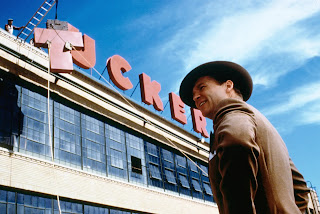
Coppola dedicated his next film, “Tucker: A Man and His Dream” to “Gio, who loved cars.” An insistent dream project of his, Coppola turned to long-time friend George Lucas for the financing of the film. Jeff Bridges plays Preston Tucker, the designer of a controversial prototype automobile. Coppola had originally seen the project as a musical, but instead made the film in the style of Frank Capra, through dramatic lights, shadows and lush colors.

Bridges plays the visionary with post-war brio, a big infectious optimism that dominates the screen without managing to come off as hokey or insincere. (He later duplicated this for “Seabiscuit.”) He is helped along in the process by Martin Landau as Abe Karatz, Tucker’s financial agent. One of the hallmarks of Coppola’s films is their flair for on-the-nose casting. “Tucker” features Joan Allen as Preston’s wife Vera, Christian Slater as his son Preston Jr., Frederic Forest as mechanic Eddie Dean, and Jeff’s father Lloyd as a senator doing the bidding of established automakers who see the new car as a threat.

Early on, as Tucker attempts to assemble his financial backers, he shows a room of bureaucrats graphic pictures of auto accident victims:

“The Big Three in Detroit have been allowed to make billions of dollars without spending one dime on safety. What I know, what you know and what the public knows is that they don’t give a damn about people. All they care about is profits. And let me tell you something, and I mean this from the bottom of my heart, the entire automobile industry of America is guilty of criminal negligence. And if it were up to me, it would be tried and convicted of manslaughter.”

He later pays a heavy price for these words. Tucker is the voice of anti-corporate America, celebrating the spirit of maverick entrepreneurs who chase their dreams. As far as he is concerned, the fundamental feature of America is free enterprise, in the freest, most swashbuckling sense of the words. But with investors come contracts, responsibilities, the realities of business. Still, he is unwilling to compromise his vision, insisting the car should have seat belts, a rear engine, and other features later adopted by Big Auto. His enthusiasm draws risk-taking investors, and the attention of the enigmatic Howard Hughes, played with characteristic loopiness by Dean Stockwell. 

Tucker eventually finds himself in court, with large, faceless forces gathered against him to sabotage his plans. It’s not too hard to see this as Coppola’s comment on the filmmaking process, aided by his fellow outsider Lucas. Landau’s character, scared that his past will tarnish Tucker, relates the story of how he always heard his mother say, “Don’t get too close to people – you’ll catch their dreams.” This was a mistake, he says, as she was really saying “germs.” But Coppola wants you to catch the dream, because that’s what the story, indeed the movie, indeed all movies, are about: Catching somebody else’s dream.

“It’s the idea that counts…and the dream,” Tucker says, at the end, walking out of a courtroom, denied his factory yet exulting in carloads of people riding around in the only models he was able to make, taking satisfaction in the extent of his limited accomplishment. 


Tuesday, January 18, 2022

Tom Wolfe among the Stoics


It is through an accident midway into Tom Wolfe's "A Man in Full" that the novel's incarcerated character, Conrad Hensley, discovers stoicism. Disappointed that he has picked up the wrong book by mistake, he wades into a thick, scholarly assemblage of the collected writings of the stoic philosophers only because he has nothing else to read in his cell.

His heart soars, though, when he encounters the life of Epictetus, the slave who was imprisoned, tortured, faced death, and went on to teach the outlook that prizes endurance, acceptance, and personal responsibility. When Conrad reads Epictetus' words - "We must die. But must we die groaning? We must be imprisoned...but must we whine as well?" he comes away invigorated for the action that follows.

Stoicism, which began in Greece and acquired a Roman flavor, is having a moment, as they say. The New York Times last year referred to it as "not so much a philosophy as a collection of life hacks for overcoming anxiety, meditations for curbing anger, exercises for finding stillness and calm." Several popular books over the last few years have repackaged it for modern ears, such as the cognitive psychotherapist Donald Robertson's "How to Think Like a Roman Emperor," an examination of the life of Marcus Aurelius.

But nearly two years of dealing with COVID-19, the lockdowns, the economic stress, the mass feeling of helplessness and escalating anxiety, have done their work inspiing in millions around the world the search for some kind of answer for how to cope with the evils of the day. Wolfe's novel, now 24 years old, perhaps deserves the same kind of reappraisal, for different reasons. 

At first glance, it's easy to see why stoicism would have bubbled to the surface once again. It isn't a religion, regardless of its pagan origins, so it has the glamour of antiquity and the novelty of relying on personal responsibility. No priests, no tithing, no exclusivity. What's more, it offers a very limited amount of basic principles, beginning with the idea that there is only so much one can master within the borders of one's life. Consider the words of Epictetus:

"Some things are under our control, while others are not under our control. Under our control are conception, choice, desire, aversion and, in a word, everything that is our own doing; not under our control are our body, our property, reputation, office and, in a word, everything that is not our own doing."


Interestingly enough, Netflix is set to do an adaptation of the novel, with Regina King directing and David E. Kelley producing. But one might wonder, as people did when it debuted in 1998, why a rather rational yet uninspiring set of principles became one of the centerpieces of Wolfe's second novel.

To fully understand, we have to do a little backtracking. 

Tom Wolfe began as a journalist during the 1960s, cutting a figure in New York through manic takedowns of the culturati's sacred cows of the moment, with lively profiles of the era's leading figures. He moved on to non-fiction, with works such as "The Electric Kool-Aid Acid Test," "Radical Chic" and "The Right Stuff." Then, in 1987, he published "The Bonfire of the Vanities," a scathing portrait of New York, high and low, with acidic verve that spent 56 weeks on The New York Times Bestseller List, spawned a notorious film, and summed up the go-go Wall Street ethos of the time. 

But it took Wolfe 11 years to publish his follow-up, "A Man in Full."  This time, he moved his action South to the city of Atlanta, incorporating various strands of big real estate investment, racial politics, sports, art, immigration and...stoicism. As with his previous work, Wolfe spent a lot of that time on the ground, reporting about the various aspects of Atlanta, its business and political communities, its cultural landscape, its sprawling suburbs. He had plenty of chances to see how the city saw itself.


In the novel, the main character is the real estate investor Charlie Croker, who is staring bankruptcy in the face, the loss of not only wealth but status, one of Wolfe's great themes. He's getting older. His city is changing, as is the South. He is a symbol of the past - a white star athlete from the days of one-platoon football. He has indulged his ego in debt and possessions, and now he sees the end. Through a series of twists, Croker finds himself face to face with Conrad, who acts as his evangelist for stoicism. Croker must decide whether or not to go through with a public humiliation, another of Wolfe's great themes, in the form of a press conference on behalf of a Georgia Tech football player in legal trouble. If he says a few kind words, all of his problems can be made to go away.

Instead, Charlie hands over his possessions during the public forum, knowing full-well everything he has worked for, positioned himself to take, borrowed to acquire, will disappear. The fact that Croker does this in Atlanta is telling. Atlanta, the City Too Busy to Hate, which in the 90s was riding high in a fit of world ambition that culminated in hosting the 1996 Olympics; a city known for its touchiness about its image and its aspirations.

"I don't know what you're like," Croker was saying, "but if you're like most uv'us here in Atlanta, you're driving yourself crazy over possessions. Just think about that for a second."

Of course, everything doesn't completely disappear for Charlie. He soon signs up to host an hour long television series on stoicism on FOX, of all places. Because stoicism is about endurance. 


The critic Terry Teachout at the time observed that Wolfe performed an interesting sleight of hand in  "A Man in Full," creating a story in the Deep South with the character undergoing a kind of religious conversion that has nothing to do with Christianity. In fact, none of the characters in this very Southern city seem to be connected in any way with the dominant faith of the region. Even Roger White II, whose father is a minister, seems too wrapped up in his own ambitions. This was conspicuous enough at the time to draw attention from some critics. When asked once, Wolfe said he avoided Christianity as it had basically "been done."  

But remember, Wolfe spent the better part of a decade around Atlanta in his white suit with notebook in hand, recording the details he used to create his work. Not only that, Wolfe was a son of the South himself, a native of Virginia. Granted, he once said he was an atheist, though he clarified that as "lapsed Presbyterian." This seeming indifference to the spiritual realm, when so many other aspects of modern life are rendered so vividly in his work, was also an feature of his next novel, "I Am Charlotte Simmons." The innocent title character goes to a private university after an immaculate, high-achieving high school career, but did not seem to be grounded in faith as much as her own aspirations, though it would be hard to imagine a character that age so sexually oblivious unless she had been sheltered within a church.

And also consider the last two decades since "A Man in Full's" publication. Pew Research shows the religiously unaffiliated in Georgia numbers around 15 percent, and rising, with people under the age of 40 more apt to not belong to any particular church or faith tradition. Georgia has gone from red state to purple politically, while a corresponding critique of Southern evangelicalism as a movement largely focused on political power in the age of Trump. One might ask if it's possible that Wolfe saw something stirring back in the 90s about where Atlanta, and potentially the rest of the South, was headed - "having a form of godliness, but denying its power," in the words of the Apostle Paul. 

There was a sense, at the time of its publication, that "A Man In Full" had either been too ambitious or overhyped, a sprawling followup that failed to live up to the razor sharp reputation of its predecessor. Perhaps stoicism was a hard sell to Americans at the end of the 90s, unaware of the calamities the new century would bring. Teachout, in his review of the book, pointed out as well that stoicism, in spite of its remarkable staying power, has never been able to attract the kind of mass appeal of Christianity, largely because it relies on an intellectual code firmly rooted in the here and now. Where the call of Christ is situated outside the individual, and meaning and purpose come from a divine source, modern stoicism appeals to the inward looking and inwardly situated. That makes it perfect for the modern self-situated consciousness, but with a near fatal weakness. The problem for most people looking for answers is that they know themselves well enough to know the answers don't lie within, but without. 

Croker's speech, delivered in a rustic Georgia twang, tries to cut through to the essential quandary in a room full of people, living in their own versions of accountability, who listen believing he has lost his mind:

"What is the human body? It's a clever piece of crockery containing a quart of blood. And it's not even yours! One day you're gonna have to give it back!"

It is with these words that the new converted Charlie comes closest to Christ, who took the question a step further: "What shall it profit a man if he gain the whole world and lose his soul? And what shall a man give in exchange for his soul?" 

Saturday, July 3, 2021

Quentin Tarantino's Helter Skelter Theory of Narrative


“It was so quiet, one of the killers would later say, you could almost hear the sound of ice rattling in cocktail shakers in the homes way down the canyon." 

That's the first line of "Helter Skelter," the legendary true crime recounting of the Tate-LaBianca murders masterminded by Charles Manson - grisly killings that stamped themselves on the collective memory of America, fusing the upheaval of the 1960s, with what Greil Marcus once referred to as "The Old, Weird America," and the enduring blood and death mythos of Hollywood. 

That opening, written by Vincent Bugliosi and Curt Gentry, tells the real story of what happened over two nights in California in 1969. A crew of hippie castoffs were inspired to commit a string of bizarre, motiveless murders that struck down "the Beautiful People" of the time, reducing them to "pigs" seemingly deserving of dehumanizing slaughter. That kind of story would seem an obvious draw to a filmmaker like Quentin Tarantino. Thus his 2019 film, "Once Upon a Time In Hollywood."

But two years later comes Tarantino's first novel, bearing the same title. On one level, you can say it tells the same story, but that would also be false, just as false as the Hollywood ending he gave the murder of Sharon Tate and four others in his movie. 

The book subverts an obvious Hollywood tradition - the movie tie-in novelization, which usually appears at the same time as the film, for maximum monetization. And just like the time it celebrates, Tarantino's book comes in a retro, mass-market paperback edition that calls to mind hundreds like it available in second-hand bookstores across the country, their yellowed, dog-earred pages awaiting a new generation of readers anxiously turning the pages to keep their copies from falling apart. 

The 400-page book also subverts another strategy - the tie-in following the movie, note-for-note, a prose re-rendering of the film, with some expansion of character motivations, but a work subservient to the screen, the prose usually reflecting a tight deadline. This book comes advertised as, "The new novel based on the film." 


Before I get to the book, it's necessary to talk a little about the film. "Once Upon a Time In Hollywood" tells the story of aging screen actor Rick Dalton, a once-promising television star, perpetually knocking on the door of big time features, who never quite got the same break as contemporaries such as Steve McQueen and Clint Eastwood. It's now the 1960s, and his career appears to be sinking as the needs of Hollywood change with the permissiveness of the times. Rick is the past, as is Cliff Booth, Rick's friend, stuntman and gofer, a no-nonsense veteran who is also playing out the string on Rick's payroll. Hovering in the background of their careers is Rick's next-door neighbor, Sharon Tate, who the audience knows, died at the hands of the Manson family on Aug. 9, 1969.

James Cameron's "Titanic" tells another familiar story - the sinking of the ocean liner - but takes three-and-a-half hours to tell the story. The audience knows what's going to happen - but Cameron gives you Rose and Jack and their love story so that you will learn to care about them, and thus, care about the tragedy of more than 1,500 people. Spoiler: The ship is going to sink. The iceberg cannot be stopped. The twain shall converge. 

But "Once Upon a Time" is a comedy, and the unsuspecting audience enters the film with the knowledge of the Tate murders hovering menacingly in the background, providing steadily escalating tension. "How's this going to end?" they wonder, knowing there's nothing remotely funny about a young, beautiful woman in her ninth month of pregnancy being stabbed to death. Then Tarantino transforms Chekhov's gun into a flamethrower, and the Manson killers into slapstick villains getting their just deserts, at least on the screen. Rick is then invited up to an evening with Sharon, Jay Sebring, Abigail Folger and Voytek Frykowski, all very much alive. Their show must go on. And by this ending, we barely care that the two hours of meandering plot we spent with Rick and Cliff have virtually no connection to this ending.

For his novel, Tarantino takes a different course. The movie ending -Cliff's dog dispatching Tex and Katie, Rick frying Sadie - are dispatched in a few pages relatively early in the novel. We even get a look into the future to see how Rick's career benefited from his exploits against the Family. This tells us that our experience in prose will be different. In Tarantino's 400 pot-boiler pages, we are treated to elaborate backstories for Rick, Cliff, Sharon Tate, and the Family member Pussycat. Pulpy chapters of fake western storylines unfold. The director unpacks pages and pages of films and television shows - some real, some fake - until we are unsure where the real world ends and this alternate universe begins. Which is interesting, because most of the novel is situated in the very real business of Hollywood make-believe. 

The point - as with most of Tarantino's work - is cinema, the magic of getting a roomful of people to stare at a screen of rapidly moving still images, an illusion reflecting an illusion, and have their lives melt away by the intellectual force of the story unfolding before them. There's a passage, familiar to the film, where Sharon Tate takes in a matinee of "The Wrecking Crew" in order to judge the audience's reaction to her taking on pratfall comedy. But in telling the story, the director Tarantino recounts a story of Tate's husband, the director Roman Polanski, and a particular shot in "Rosemary's Baby." Why did he insist on framing the shot in a particular way? Sharon learns months later when she sees the film and watches hundreds of people crane their necks simultaneously in order to see something the shot obscures - something they obviously can't do. 

"Why did he do it?

Because he could." 

That could serve as an adequate explanation for why Tarantino decided to give us this novel, not quite a companion piece to the film, or a compliment to the film, but something else entirely. We learn that Cliff, personable fellow he is, is nonetheless a calculating killer who holds his instincts in check most of the time, Bruce Lee notwithstanding. Rick is a drunk because he's undiagnosed bipolar. Pussycat became a member of the family because Charlie Manson bribed her father by pimping out family members to him. 

There are plenty of examples of Tarantino's flair for dialogue. One also gets the idea that Q understands the differences between his preferred medium and the printed page. A chapter where Pussycat breaks into a home, with Charlie's disembodied voice following her, goading her, instructing her, is well-done and succeeds in rendering something close to the spooky mystery of the real Manson on the page. And in the extensive fake filmographies Tarantino renders, he even places himself at the helm of a film in the 1990s that he never made. 

The book also shares the film's celebration of a kind of male bonding and unconscious, oblivious masculinity that contemporary pop culture feels uncomfortable with. We know that Cliff is smarter than Rick, but Rick, with his constant grousing about his career and the course of his life, his proud ignorance, his thin skin, is both calculating and taciturn, and ultimately, a survivor. We get the impression that Tarantino wants us to acknowledge there is a kind of epic grandeur in cast-off cowboys, fighting against the demands of time and audience. This world of make-believe is real. In page after page, we understand that Tarantino truly loves his menagerie of serviceable TV westerns, Italian spy knockoffs, vaguely erotic European thrillers, bubble-gum rock, and 8-track tapes, where Burt Reynolds, Bruce Dern, Jim Stacy are constantly downing drinks at some obscure California bar, swapping stories. 

If there is another discernible theme hidden in the novel, it is hidden in plain sight and shared with the film - the possibilities that brood behind every second of our lives. In "Once Upon a Time," Sharon Tate does not die. We do not know if she had a healthy baby, or if her marriage improbably survived the sixties, given what we know of Polanski's private life. She would be 78 years old at the publication of Tarantino's novel, and we would presumably know if her career ever fulfilled the promise that eluded her in life. But we know from the book that Rick becomes a regular guest on the Tonight Show with Johnny Carson, where perhaps he was asked, yet again, to tell the story he grudgingly recounts three times in the book - how close he came to getting the role in "The Great Escape" that eventually went to Steve McQueen. 

This was a plot point in the film, but it gets more of a workout in the book. One reason for this story is McQueen's position in the mythos of "Helter Skelter" - he was almost in the Tate residence the night of the murders, and had supposedly been marked for death by the Manson family. But not only is Rick asked to recount the story several times, he is brought face-to-face with McQueen outside the gates of the Cielo Drive house. When Rick gives the story a final airing out, he attempts to destroy it. His point - he was never going to get the part. Yet the story dogs him, because of the tantalizing possibility of what his career might have been. He can't allow himself to go down that road, no matter how much he might want to. It's worthy of mention that, as Tarantino gives us a limited view of what becomes of some of his characters in the years to come, he omits Sharon Tate. But the nature of tragedy is not limited to her. Jim Stacy, after his time on"Lancer," lost an arm in a motorcycle accident to a drunk driver. He made a comeback, but eventually pleaded no contest to molesting an 11-year-old girl. After fleeing to Hawaii and attempting suicide, Stacy served a six-year prison sentence, before eventually dying of anaphylactic shock after receiving an antibiotic injection. He could have used several alternate outcomes.

The point is the movies, even between the pages of the book. The personalities at war with each other on sets, the compromises and coaxings needed to get performances on film, the vagaries of screen personas and how they are used to lead an audience, making careers rise and fall. The book ends, not in August with Rick and Sharon unaware of what happened in our world, but back in the Spring of 1969, with Rick on the phone with young costar Trudi Frazer, going over lines the night before a big scene, so that the show will go on, as it must. 

Set Your Fields on Fire

The award-winning novel by William Thornton
Available now

Tuesday, May 25, 2021

The True Account: The Gospels - a new translation by Sarah Ruden


About fifteen years ago, I was standing in a museum on the campus of Emory University in Atlanta, looking at a small, 2,000-year-old limestone box, an ossuary, which had once held the bones of someone from 1st Century Palestine. Discovered in Jerusalem in 1990, the box bore an inscription in Aramaic, “Yehosef bar Qayafa" - Joseph, son of Caiaphas. It is the opinion of some scholars that this held the bones of Caiaphas, the high priest who conducted the trial of Jesus. This man, at one time, heard another man standing before him speak these words, "You'll see the son of mankind sitting to the right of the power and coming with the clouds of the sky."

Looking at that box, I realized I was quite possibly standing at one remove from a physical link to the story that has dictated and dominated my life. I am a Christian. I gave my life to Christ at the age of seven in a Southern Baptist church in Alabama. I have taught Sunday School at two churches for almost 20 years. I read the Gospels twice a year. But looking at this stone box was sobering and exhilarating - I am separated in so many ways from the story I have told so many times.

I was reminded of this reading Sarah Ruden’s new translation, “The Gospels.” Yeshua ben Yosef – otherwise known as Jesus of Nazareth, the son of Joseph, the Christ – spoke a different language than I do. He lived on another continent in another time. The Jesus I know through my church has passed down through two millennia worth of cultural and linguistic compromises – some would say distortions. The fellowship he enjoyed with his followers is utterly alien to my experience, and that of many in the 21st century church. Jesus didn’t go to covered dish suppers. He wasn’t taught with felt boards at Vacation Bible School, then offered a cookie and Kool-Aid. He took few recorded political stands and never needed to tell someone who to vote for. He told his followers they had to be willing to give up their mothers and fathers, and even hate themselves, to be his disciples. 

Some people reject this outright. Others are fine with the spirit of the message but not at all at home among Jesus' professed followers. Some people try a compromise – and listen to the parts of the Gospels that make them feel better. Some are uneasy not just with the words, but how we received them and how they’ve been passed down. Others are OK with the idea of Jesus but made uneasy by the actual words on the page, regardless of how we got them.

What Ruden does is go back to the actual words on the page – the Greek manuscripts settled on by scholars from surviving copies, and translate them into a rough, readable English. The result is a reminder that the Gospels are undeniably the most successful persuasive texts in human history. It’s also a reminder that they succeed largely because of their subject matter, and not because of their authors’ particular gifts. 

To begin with, the Gospels are a weird quartet of books. I say weird because they are written in Greek and recount moments that happened among people who spoke Aramaic. Their four authors come from different cultural backgrounds – Jewish, Greek and Roman. They purport to mix eyewitness accounts with recounted stories. We aren’t sure when they were written. Some scholars date them within 50 years of the events recounted. I’m no scholar, but I tend to agree with those who date them earlier. Full disclosure – I am not a Biblical scholar but a believer in every aspect of the Nicene Creed. So if you ask me how I feel about the Gospels, I will say that they are real and I believe what they report is genuine. 

Ruden's translation is not for everybody. Her decision to render God in lowercase, to reflect the way the word appears in the original manuscript, may rub many as irreverent. Reviewers have also called attention to her decision to give us the names in the original Greek. Thus, Jesus is “Iēsous,” John the Baptist is “Iōannēs the Baptizer,” and so on. Instead of Apostles, they are “envoys.” Mostly, they are “students” instead of disciples, which I kind of prefer. Some readers will stumble over this. I found it slightly liberating. It renders the story as practically new, and no matter what name the Savior has, He is instantly recognizable.

Ruden states in her introduction that her aim is preserving the text’s style and content. Any translation is a negotiation, especially one over 2,000 years. Taking the actual words and transferring them into another language is a tricky business, especially in accurately capturing idioms that no longer exist. But she understands, on one level, what she’s working with. The point of the Gospels, she says, is Jesus.

“The Gospels are an inward-looking, self-confirming set of writings, containing some elements of conventional rhetoric and poetics but not constructed to make a logical or aesthetic case for themselves; the case is Jesus, so the words don’t stoop to argue or entice with any great effort, as if readers are supposed to have the choice to yawn or say “what?” or turn up their noses in the manner of an ordinary audience.”

As I said earlier, the Gospels success has not been largely because of how the message is conveyed, but the message itself, and the One giving it. There are moments of eloquence in the prose, but the memorable passages are almost solely the words of Jesus. But where the text itself is memorable, Ruden concerns herself with rendering the words as plainly and simply as possible. Accordingly, the opening of John’s Gospel, rendered in the King James as “In the beginning was the Word, and the Word was with God, and the word was God,” becomes, “At the inauguration was the true account, and this true account was with god, and god was the true account.” Instead of emphasizing Jesus as being one with God in speaking creation into existence, the sentence instead makes it clear that Jesus was also the ultimate truth of existence, and nothing exists without Him. The reader will have to decide if this is better, worse, or just different.  

To test her work, I read Ruden’s “The Gospels” largely aloud to myself, to pick up on any rhythms in the language. Some were recognizable as existing in other translations. But the best thing about this translation, for me, is how it takes very familiar passages and renders them almost new. The picture that emerges feels less polished, more human, more accessible, with the meaning unchanged. "Be perfect, just as your Father in Heaven is perfect" becomes "So be what you were meant to be, be complete, as your father in the sky is complete!" As she said, tone and point of view can depend sometimes on a single word. That, to my mind, is God dwelling in every "jot and tittle," to employ the King James language. As with everything else, the meaning, the severity, the importance of every word rests on how much faith one is willing to invest in the word.

There are little moments throughout the Gospels where small details, usually glossed over in other translations, emerge. As when Jesus says to Judas in the Garden, "Do what you came for, pal." By taking what's usually rendered "friend" and converting it to "pal," it's possible to see a Jesus who is resigned, disappointed, and unwilling to countenance any deceptions about what is happening to Him. I kept thinking to myself that, if the language was made even more contemporary, Jesus would have said “bruh” instead of pal. Instead of "Woe to you scribes and Pharisees, you hypocrites!" Ruden gives us "You have it coming, scholars and Farisaioi, play-actors!" which sounds less formal and more menacing.

Ruden presents the Gospels in the order that scholars now think they were written – Mark, Matthew, Luke and John. This allows you to see how the three Synoptic Gospels share episodes, and how they elaborate on them. I felt some of her footnotes were either unaware, or unwilling, to rely on the bulk of Biblical contextual thought to explain certain episodes, which leads her to cast doubt what is being recounted in relatively routine passages, such as the presence of troops when Judas betrays Jesus. 

Reading the Gospels can be a frustrating experience because of what the text doesn't say. For example, I would like to know more about the dynamics among the Apostles. Which one was the jokester? We know that a few had nicknames (The Twin, Sons of Thunder, the Rock) but what about the others? What were their backgrounds? We know one was a tax collector, and another was a Zealot - representing the two political extremes of the time. Were there any other indications about Judas before the end? There are other mysteries, of course - what happened to Jesus during his childhood? From the time in the Temple to the beginning of his ministry? Why does Joseph disappear from view after Jesus' adolescent episode? What about the individual stories of the people He healed? Matthew tells us that, when Jesus died on the Cross, "many bodies of the saints which slept arose, and came out of the graves after his resurrection, and went into the holy city, and appeared unto many." And that's it? No names? No details? The reason, though, is that the story is about Jesus. The story is always about Jesus. We are only told as much as we need to believe.

A personal confession here: The Gospel of John, of course, stands out from the other three as being the more personal reflection on Jesus, the most theologically bold, and the one with the longest passages of Jesus’ recorded teachings. I love the language of it, but there are parts of it that challenge me. The chapters toward the middle, where Jesus antagonizes his adversaries with long, complicated teachings, and his long goodbye to the disciples at the Last Supper, are sometimes hard going for me for reasons I haven’t been able to work out for myself. Jesus’ elaborations on how He is in the Father, and the Father is in Him, while not confusing, sometimes feel repetitive and I perceive I’m missing something. But I wouldn’t sacrifice a syllable of it all, because it reminds me that the text isn’t there for me to like. It renders Jesus to me in a way that challenges me, giving me only the barest idea of how challenging He could be in the flesh to his followers. The passage in Luke where Peter falls to Jesus’ feet and begs Him to leave, “Get away from me, because I’m a wrongdoer, master!” seems right on the money, for both the fisherman and me. 
 
The Jesus in John is not bashful about who He is - He is the Way, the Truth, the Bread of Life, the Good Shepherd, the Vine, the Resurrection and the Life. And just like my experience in front of the ossuary box, John corrects me with the knowledge that Jesus is infinitely more than I can imagine - not some vague cosmic force, but a personality, with ultimate wants and aims that I would be foolish to ignore or fight, even though I really give it a good try.

That’s why Ruden’s version of John - “The Good News According to Iōannēs” - is so welcome. She renders Jesus' grief at Lazarus' tomb in all of its pathos. For example, in a footnote, Ruden explains that the shortest verse, usually rendered as “Jesus wept,” employs a verb that depicts tears on the face. But in the surrounding verses dealing with his response to the death of Lazarus, Jesus “howled within, with his very life-breath.”

And the gentle kidding of Jesus in the 21st chapter of John when he asks the disciples from the seashore, "You don't have anything to nibble, youngsters?” This is the resurrected Jesus, playful, just before he needles Peter, while at the same time rehabilitating him after his denial, equipping him for the work ahead in leading the disciples.  

I grew up in a church with several hundred members. I walked the halls and remember those musty smells and the faded print of Jesus as a shepherd hanging on the wall. I associate the Gospels with many things that don't have anything to do with Roman occupied Judea, such as old deacons fumbling the collection plates in the vestibule and grape juice in plastic communion cups and the old school bus that took us to summer camps. For others, their memories of Bible verses and the politics in the pews carry much darker, less divine associations. But the Gospels exist, and I read them regularly, to steer myself toward their subject. Too much time away, and the Jesus we create in our minds is either too forgiving or not forgiving enough. He either laughs too easily at our jokes or cocks a fist over our fallen spirits. That Jesus cheers us on to overturn the tables in our Temple without His help, or shuts the door to ignore our knocking. Opening up the Gospels, we are confronted with the true face - welcoming and challenging, forgiving and formidable.

From Craig Blomberg’s “Jesus and the Gospels,” which is one of the best one-volume resources on the Gospels in my opinion: “Jesus, like his earliest followers, was convinced that how one responded to him was the most important decision anyone could make in his or her life. On this response hinges one’s eternal destiny.” If Ruden’s work has done anything, it has brought us that much closer to the real figure who stole away to Jerusalem out of sight, only to shout to the crowd in the ancient capital, “You do know me and where I’m from!”

Set Your Fields on Fire

The award-winning novel by William Thornton
Available now