Back
before the lockdown, before I or most anyone had even heard of
COVID-19, I made a silent resolution – in 2020, I would read every play
written by William Shakespeare in as close to the order we think he
wrote them as possible.
I’m not even sure why I resolved to do this. After all, January was many years ago.
I
probably hoped it would make me a better writer. They say Melville read
through Shakespeare’s plays before he wrote “Moby Dick.” He also died
in relative obscurity and near poverty, which is not something I aspire
to, as career moves go. We don’t know for sure when Shakespeare wrote
each play, but we have a rough idea. That was enough for me. It was
something I had told myself for years that I would eventually do. And
hey, who knows what the new year will bring, right? Or as Shakespeare
himself put it: “O, what men dare do! What men may do! What men daily
do, not knowing what they do!”
I started with “The Taming of the Shrew” on Jan. 1. I resolved to also
reread the ones I had already made my way through. I made a few
modifications to the list – I took in all the history plays dealing with
English kings in their historical order, to see the unfolding stories. I
spaced out the readings because I didn’t want to go too quickly.
Usually I read about six plays a month, often in two or three days' time
for each. I breezed through the better ones – some were a harder fight. On the week of Halloween, I finally finished “The Two Noble Kinsmen,” the 38th and
final play.
When I told a few people what I was doing, they asked, “How is it?” My answer was usually the same:
He’s good. He’s really good.
Just
writing about the greatness of Shakespeare seems a trite thing to do,
because it’s been done to death. But there were times as I was
reading where I thought to myself, “Man, he’s having a ball.” It was an
unexpected pleasure to see Shakespeare’s style develop over time. He
goes from being a clever writer with a gift for wordplay and rhythm into
a genius at plot, character and action. And then he goes beyond that,
growing into a philosopher and a prophet, comedian and mourner. And
beyond that again. And again.
The
sheer inventiveness of the man is astounding. It’s easy to say that
about someone whose writing has endured for four centuries, but to
actually witness it flickering on the page, time after time, was a
constant miracle. I discovered things I had never noticed about the
plays I had read and seen before. I developed a new fondness for some of
his comedies, which hadn’t really moved me so much. I would open plays I
had no idea about and suddenly be carried away.
This
man, who probably did more to shape our language and culture than we
will ever know, took the five act play as his laboratory and flung away
whatever the rulebook was. I was surprised by his history plays, and how
he put the deepest observations into throwaway characters, so that the
highborn will not listen to them, to their collective dooms. You can
often see him, off in the shadows, deciding that the audience needs a
break - so let’s have one scene of jokes and double entendres to lighten
the mood. So, we have an all-male troupe of actors? Let’s have one of
them who is supposed to be playing a woman instead play a woman
pretending to be a man. Confused yet? It gets better. Oh, you think that
character’s dead? Well, just you wait. And to think he just turned this
stuff out year after year, page after page, play after play.
It
was interesting to see how he shifted over time. He migrates from
sometimes lighthearted comedies and history plays, around the midpoint
of his career, to a vision that grows darker and more acidic. “Julius
Caesar” is still my favorite, even though it peaks with Marc Antony’s
funeral oration, and I couldn’t care less. “Hamlet” remains an endless
sea to sail on, as profound a meditation on grief as it is on the human
psyche: “What a piece of work is man…” “Troilus and Cressida” was
absolutely blue black with cynicism about war and humanity. “Macbeth” is
a wonderfully compact, brilliant horror show, still as spooky as when I
first encountered it. “The Comedy of Errors” was genuinely funny and
has been shamelessly stolen from countless times, just as it was likely
stolen by him. “The Merry Wives of Windsor” barely registered – which
was reassuring, as even Shakespeare had moments when he was probably
doing it for the money.
And in a way I could never have foreseen, Shakespeare got me through the
lockdown, the disappointments, the disasters, and the endless
complications of 2020. About the time our dining rooms and theaters
closed, I had made my way to “Romeo and Juliet,” where I was reminded
that if Friar John had not been confined to a house suspected of
harboring the plague, Friar Laurence would have received the letter that
might have kept the star-crossed lovers alive. When Facebook kept
reminding me of what Shakespeare did when he was a prisoner of the
plague, I could read it myself in “King Lear,” with the assurance that
“cold night will turn us all to fools and madmen.” As Americans took to
the streets in protests and violence over issues of race, I saw Othello
convulse in murderous anger because of the sinister machinations of
Iago. I drew toward the end of the journey just as the presidential
campaign headed toward its climax, with the court intrigues of Henry
VIII speeding me along, reminding me to “Heat not a furnace for your foe
so hot that it do singe yourself.”
I
confess that I got a little weary toward the end, like a bad runner in
the last mile of a marathon. But then came “The Tempest,” with the story
of an old magician on a lonely island enacting his revenge, and then
moving on to something more benign. It reminded me of the reason I had
taken this journey in the first place. The air, cramped and constrained
by the pandemic, was again filled with luminous magic. “We are such
stuff as dreams are made on, and our little life is rounded with a
sleep” is not just a bit of high-flown whimsy. More than once,
Shakespeare reminded me, even in the worst and most challenging of
times, about the gift of life itself, the inexhaustibly gracious wonder
of existence. About the deep and abiding hunger of evil. About the human
heart, lacerating itself and others, then suddenly drawn back from the
abyss by that most alien and most welcome thing, love. I had seen all
these pageants play out on the page, and on the stage, and in different
versions on my television and in our streets. But as for the plays, our
revels now had ended.
As
I said, so much has been written about Shakespeare that it seems silly
to add a few lines more. Whatever I think he says to our time, I think
it’s more important that we remember what he says for all time. Our age,
seemingly teetering on the brink of disaster, with all of us filling
the air with selfies to document it, may argue about what Shakespeare
meant, or means, of if he still means anything at all.
But
when we do that, I think we sometimes lose sight of the very real man
who I feel a little closer to now - an actual flesh and blood human,
scribbling on deadline, trying to avoid putting those particular lines
into the mouth of a barely competent actor he knows is incapable of
saying them, mindful of the previous night’s intake at the box office,
knowing that the audience is impatient and unforgiving, but ready to go
anywhere that will leave them spellbound. For that man, where in his
mind it was probably always 10 minutes to curtain, what we might think
of his writing may not have entered into his mind.
But we want him to have cared, which shows how much he matters to us, still.
Potential spoilers of "The Batman" follow. You may also not want to read this if you don't know how Bruce Wayne's parents died.
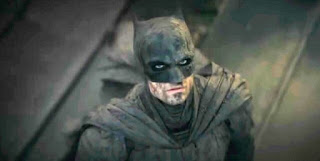
This weekend’s premiere of Matt Reeves’ “The Batman” is yet
another reboot of the cinematic Dark Knight Detective. At nearly three-hours in
length, the film presents a Batman who is more of an armored sleuth than his previous
versions, a character who would be at home in “Blade Runner,” “Mean Streets,” "Seven," “Zodiac,” or even "Chinatown." A few critics have pointed out that, despite its length, the film
is one of the few versions of the story which does not tell us how Batman came
to be. Robert Pattinson’s version arrives fully-formed, confident the audience
knows his backstory.
In the final moments of “The Dark Knight,” as the manhunt
for Batman begins following the death of Harvey Dent, Commissioner Gordon’s son
asks why. “Because he’s the hero Gotham deserves, but not the one it needs
right now,” his father replies. Our cinematic versions of Batman have grown progressively darker over
time, so that every few years we presumably get the Batman we deserve. And
because of this, the way the films talk about his origin have grown
progressively more complicated.
The first appearance of Batman’s beginning was in
Detective Comics #33, in November 1939, “The Batman Wars Against the Dirigible
of Doom.” In it, the legend of the Batman and how he came to be the “Eerie
Fighter of the Night,” the “Weird Figure of the Dark,” is positioned some 15
years in the past, putting it around 1924, before the Great Depression. Thomas
Wayne, his wife and son are walking home from a movie when they are accosted
by an anonymous stickup man who wants Martha’s necklace. (Martha is not named
in this first appearance)
When Thomas steps in front of her, he is gunned down. “You
asked for it!” the unnamed killer says. Martha begins calling for help from the
police, and the robber shoots her. “The boy’s eyes are wide with terror and
shock as the horrible scene is spread before him,” the text tells us. Two
panels later, Bruce, alone by candlelight, his hands gripped in a kind of
feverish prayer, vows, “…and I swear by the spirits of my parents to avenge their deaths
by spending the rest of my life warring on all criminals.” After years of
training, in science and bodybuilding, Bruce realizes his wealth gives him the
opportunity for vengeance.
“Criminals are a superstitious, cowardly lot. So my disguise
must be able to strike terror into their hearts. I must be a creature of the
night, black, terrible…a...a…” It is at the appearance of a bat outside his
window, which Bruce takes as an omen, that the Batman is born. And thus is the
character’s origin told in two comic book pages, 12 panels in all.
It was 50 years later before those moments were captured in
Tim Burton’s “Batman.” The campy sixties television show only alluded to the Wayne
murders without actually showing them, and Burton’s visual style was an antidote
to the bright colors and in-jokes of the memorable show.
The reporter Vicki Vale (Kim Basinger) tails Bruce Wayne
(Michael Keaton) as he makes his way to an obscure corner of Gotham City, where
he unwraps two roses and leaves them. Vicki relays this to the reporter
Alexander Knox (Robert Wuhl), who digs into the archives and finds out why. A newspaper on microfilm reveals,
“Thomas Wayne Murdered: Only Child Survives.” (Again, Mrs. Wayne’s name is not
revealed). Knox tells Vale that Wayne is “really screwed up.” It is only later,
after Bruce Wayne views the newest video challenge by the Joker (Jack
Nicholson), that he makes the connection with something the criminal said to
him in Vale’s apartment.
It is nighttime at the Monarch Theatre. “Footlight Frenzy”
is on the bill. As with the rest of the film, the look is a kind of neo-retro,
a noir Norman Rockwell – it looks like the thirties even though that would make
Batman considerably older. The Wayne family are dressed as the very rich, and the shot is
framed so that we are looking up at them from Bruce’s perspective. There is a
chill in the air as we can see the happy parents’ final breaths. This is the
idealized childhood, just at the moment it is snuffed out. There are two men in
overcoats following from a distance.
Bruce looks back, the first to detect something amiss. Two robbers
appear, one silhouetted. The other grabs at Mrs. Wayne’s pearls. Thomas Wayne
intervenes, and is shot. Another shot follows. The gunman, his face still
obscured, asks, “Tell me something, kid. You ever dance with the Devil by the
pale moonlight?” The gun is pointed at Bruce, as the robber steps forward, revealing his face. It is the young Jack Napier, the future Joker, smiling his even-then-rictus grin. He notices something out of the corner of his eye. The shots have drawn attention. They must
leave. “See you ‘round, kid,” he says, unaware of what fate has in store for
both of them.
Burton’s version, of course, is a departure from the comic,
where the Waynes were killed by a low-level criminal named Joe Chill. By tying
the Joker to the beginning of Batman, the film underlines its “War of the
Freaks” story, as one ghastly figure rises up to combat another. But the first
appearance of Thomas and Martha Wayne is seen through a mist of childlike
reverence and love. Knox, who is, we would assume, a good reporter, might understandably have heard of the murder of someone as prominent as Thomas and
Martha Wayne. Yet he seems unaware until he researches it. This, mixed with the
visual style, reinforces the idea that the Waynes’ death was in the distant
past, practically relegated to legend.
There is a fleeting image of the moment in Joel Schumacher’s
1995 “Batman Forever,” when Bruce Wayne (Val Kilmer) undergoes a therapy
session with the psychologist Chase Meridian (Nicole Kidman). Dr. Meridian
overturns a rose vase, and Bruce has a flashback to the alley and the sight of
the single gunman. He explains the discovery of his father’s journal on the day
of the wake for his parents, and how he fell into a pit and had his first
encounter with the omen of the bat.
During the murder in Burton’s version, Martha Wayne’s pearls
mingle on the ground with spilled popcorn. Each time the Wayne murders appear
in screen, the pearls are significant, an obvious symbol of wealth, as well as the
mystery of the feminine, purity lost. In the original comic, it is unclear what
kind of necklace Martha Wayne was wearing. The cinematic image may have been
borrowed from Frank Miller’s seminal 1986 limited comics series, “The Dark
Knight Returns,” where the image of the broken string of pearls may first have
appeared. It’s something we will keep returning to with each retelling.
When the murder was revisited in Christopher Nolan’s “Batman
Begins” (2005), Bruce as a boy falls into what appears to be an old well while hiding from Rachel
Dawes. It is instead an entrance to the underworld - the old caverns underneath Wayne Manor. There, he encounters perhaps hundreds of bats, which frighten him. He is
rescued by Thomas, who draws him up by rope, foreshadowing
Bruce’s future crime-fighting career. “Why do we fall?” Thomas asks his son.
“So we can learn to pick ourselves up.” But Bruce is left with nightmares of
bats so vivid that they make him uncomfortable later during a performance of
the opera “Mefistofele,” a retelling of the Faust legend, a man who makes a
bargain with the Devil. Batlike creatures dance on ropes to the infernal music.
“All creatures feel fear,” Thomas told his son earlier, “especially the scary
ones.”
Because his son wants to leave, Thomas encourages their
departure from the theater out a side door into an alley. But the family
encounters Joe Chill, who wants Thomas’ wallet. He manages the situation in a
calm voice, handing it over where it is unfortunately dropped. Joe is
scared; the gun shakes. He bends down to fumble the wallet into his hand, but
he wants jewelry as well. Thomas jumps in front of his wife, is shot, and Chill
grabs for the pearls, breaking them. But Nolan doesn’t make a show of the
necklace breaking. Instead, the robber runs off, leaving Bruce alone. “It’s
okay,” his father says. “Don’t be afraid.” This is significant, because Bruce
will blame himself for their deaths. If only he hadn’t been frightened, he
thinks. His fear will later be channeled into anger.
The death takes on more resonance later into the film and in
Nolan’s Dark Knight trilogy. When Batman (Christian Bale) says his final goodbye to Jim Gordon
(Gary Oldman), Gordon begs him to reveal his identity, so people will know who
it was who saved Gotham City from a soon-to-detonate nuclear device. “A hero
can be anyone. That was always the point,” Batman says, calling back to the murder of his parents, when young Bruce first met Gordon. “Anyone. A man doing
something as simple and reassuring as putting a coat around a little boy’s
shoulders to let him know that the world hadn’t ended…” After a moment, Gordon
realizes that Batman is Bruce Wayne.
Not to impose too much reality on the moment, but one would
assume that Gordon, after decades on the Gotham police force, would have had to
reassure countless children at crime scenes. Gotham is, after all, a very rough
place. So we might safely assume that he had long harbored some suspicions as
to Batman’s true identity, now confirmed. (Or maybe not. It is a movie, after
all.) Of the many murders Gordon investigated in his career, the case of Thomas
and Martha Wayne would have been a memorable one. But again, the Waynes are
seen and remembered benignly. Thomas is a doctor, but he runs a billion-dollar
company responsible for Gotham’s public transportation system, which is tied
into Wayne Tower, and Thomas tells Bruce about the needs of the city’s underprivileged. He is
mindful of economic hardship, and imparts to his son a sense of public stewardship.
To borrow from another source, because of his great power, he has…you know the
rest.
When once again we see the origin story, it is at the
beginning of 2016’s “Batman V. Superman: Dawn of Justice,” Zack Snyder’s partly-maligned, partly-magnified grim epic. The familiar scenes play out in a montage.
It is the double internment in the Wayne family mausoleum. Young Bruce runs
away, called after by Alfred (Jeremy Irons). But as he runs through the forest
around Wayne Manor, and falls down the abandoned well, he cannot escape the
memory – he and his parents are leaving a theater. “The Mark of Zorro” is now
playing, but the marquee advertises “Excalibur,” John Boorman’s 1981 retelling
of the King Arthur legend, as coming Wednesday.
Casting is interesting here. Thomas Wayne is played by
Jeffrey Dean Morgan, perhaps best known as the evil Negan from “The Walking
Dead.” Martha is Lauren Cohan, Negan’s nemesis Maggie. One can assume, because
of the way the origin in framed for the film, that Snyder wants familiar
actors, especially for Martha, who finally gets her due in this film. But
Morgan is known for portraying villains, and also appeared in Snyder’s
“Watchmen” as the Comedian, arguably the most problematic of the deeply
troubling heroes in that film. It is a subtle change which hints at more to
come in future retellings.
The action unfolds silently, set to Hans Zimmer’s score.
Thomas steps forward as the robber confronts them, and a single shot dispatches
him. Martha attempts to shield her son, but the gun is pointed at her, the
pearl necklace caught on the barrel. The shot kills her, but also breaks the
string, sending the pearls cascading to the sidewalk. “Martha,” Thomas says,
setting up the moment deep into the movie, when Batman (Ben Affleck) realizes
he has something in common with Superman (Henry Cavill). As it appears he is
about to kill the Kryptonian, whom he has judged a menace, Superman calls out to
save his earthly mother (Diane Lane), who shares the same name as the late Mrs.
Wayne. Groans follow from a segment of the audience.
Bruce’s narration at the beginning of the movie tells that
his life before was filled with “perfect things…diamond absolutes.” Later, when
the cloud of bats engulfs him in his dreams, he realizes he has “fallen.” The
vision of bats carry him to light, but he calls it “a beautiful lie.” It
suggests that the nature of Bruce Wayne’s alter ego is inherently compromised.
He sees himself, like Mephistopheles, as a fallen creature, once a being of
light, still fascinated by the light, but twisted by darkness. Is his vision of
himself as a force for good a beautiful lie, or was it his life before?
The memory clouds even further with Todd Phillips’ 2019
“Joker,” which, like Burton’s film, ties the Batman’s archnemesis closer to
him. The film also reflects the more ambivalent nature of how American popular
culture has come to view capitalism in the 21st century. Arthur
Fleck (Joaquin Phoenix) is a failed party clown and comedian with mental health
issues, caught in the web of compromised social services and rampant poverty in
a crime-ridden Gotham City. His mother Penny (Frances Conroy) has both mental
and physical issues and, like Arthur, is unable to move up under the weight of it
all.
In the background is mayoral candidate Thomas
Wayne, (Brett Cullen) a billionaire who contemptuously refers to street criminals
as “clowns” in the language of privilege. But Penny leads Arthur to believe
that Thomas is his real father. Arthur goes to Wayne Manor and performs
for young Bruce through the gated fence until he is stopped by Alfred
Pennyworth. When Arthur meets Thomas in a theater restroom, he attempts to
connect with Thomas, who tells him his mother was delusional, that he is
adopted, and punches him. Later, Penny tells Arthur that any evidence of his adoption is false, implying that Thomas used his power and money to hide their
relationship.
This version of Thomas Wayne, as others have noted, combines
elements of President Donald Trump – his wealth, his political aspirations,
intimations of his private life, and a certain boorishness – with Hillary
Clinton, who famously mocked Trump’s supporters as “a basket of deplorables.” The
portrayal of Bruce is still innocent, but the iron fence, the butler to protect
him, the wealth, separate him from Arthur and the rest of Gotham. Is Arthur
really Bruce’s half-brother? We don’t think so, but we get a hint at the unfairness
of life. Are Bruce’s later mental health issues solely because of what will
happen to his parents, or is it also the legacy of a dysfunctional father
relationship? Though “Joker” goes to some length to make us sympathize with
Arthur, he is still a narcissistic killer. But it makes us ask the question of
just how different Bruce Wayne’s later career as Batman is from the Joker’s. Is
he beating up criminals because they’re evil, or because he wants to beat something
up?
When the Waynes leave the theatre, Gotham City is convulsed
in a riot brought on by Arthur’s murder of Murray Franklin (Robert De Niro) on
live television. At the theatre is a double feature from 1981 – Brian DePalma’s
film “Blow Out,” about a political assassination, and “Zorro the Gay Blade,” a comedic
retelling of the Zorro legend which features Don Diego de la Vega’s twin
brother Ramon, a homosexual who fights evil in a colorful vigilante costume.
Out on the street, figures in clown masks are prowling, carrying smoke bombs and signs that say “Resist." One of them
follows the Waynes out of the theater and down an alley. He recognizes the
candidate and shoots him, telling him he’s getting what he deserves. He shoots
Martha and rips off the pearls almost as an afterthought. This isn’t an act of
robbery for gain but an anonymous gunman lashing out at a symbol of wealth and
power. They are killed because of who they are, with only a secondary emphasis on what they have. Meanwhile,
Arthur Fleck is now the prince of the city, cheered on by all the masked
clowns, finally having found his tribe.
Though we thankfully do not see the murder of Thomas and
Martha Wayne in 2022’s “The Batman,” it isn’t needed. The story takes place over six extremely rainy days before the Gotham City mayoral race. The city resembles what we saw in "Joker" - a place where the safety net doesn't catch anybody, as one character says. Batman has been at work for two years, but he confides to his journal that he isn't sure he's making a difference. The action begins with the murder of four-term mayor Don Mitchell Jr. in his home on Halloween by the mysterious Riddler, presumably over Mitchell's private
affair. His death recalls the murder of mayoral candidate Thomas Wayne, 20 years
before, in 2001. (Democratic elections are necessarily dangerous in Gotham City.) Bruce
Wayne (Robert Pattinson) fixates on Mitchell’s young son, the sight of whom
stirs up obvious memories. At Mitchell’s funeral, Bruce encounters the crime
boss Carmine Falcone (John Turturro), who tells him how Thomas saved his life
through surgery on his dinner table to remove a bullet. Bruce feels the warmth of the memory, his father obviously
feeling that even a crime boss’ life is subject to the Hippocratic Oath.
It is because of the Riddler’s own vendetta against Gotham
City’s public figures that we learn he was also an orphan, housed in a home
operated by the Waynes. Once again, Gotham has a war of the freaks, sinister
half-brothers cut from the same cloth. Added to this is Selena Kyle (Zoe
Kravitz), the Catwoman, who is also the illegitimate daughter of Falcone. Now
there are three wounded figures, orphans of circumstance. Bruce is the odd one out though, because of his considerable wealth. But according to the
Riddler, Thomas Wayne hired Falcone to kill a journalist in order to shield his
wife from the public revelation of her and her family’s history of mental illness. "You'd be surprised what even a good man like him is capable of in the right circumstances," Falcone tells Bruce.
The news is naturally shattering, as Bruce idealizes his
late father. However, Alfred, wounded by the Riddler, tells a different story. Thomas
asked Falcone to intimidate the journalist, but then decided to turn Falcone
over to the police after learning of the man’s murder. He believes Falcone had
Thomas and Martha killed to prevent this. Or was it the crime boss Sal Moroni,
the subject of a memorable drug bust that made the careers of many within
Gotham City’s power structure? Or just a random criminal? We aren’t sure. What's more, Thomas Wayne created the $1 billion Wayne Foundation, with its Gotham Renewal public works program. But after his death, the money becomes a giant flush fund for the city's criminal underworld.
The question of who Thomas Wayne was, for this film, is
almost as important as that of who Bruce Wayne is. In each iteration of Batman,
there is usually a moment where some confused criminal asks of the Batman the question,
“Who are you?” or “What are you?” For Matt Reeves’ latest incarnation, he answers,
“I’m vengeance,” a refrain that reaches all the way back to his 1939 beginning.
Our origin defines our journey – and defines us - if we
allow it to do so. If Thomas Wayne was just another corrupted leader among
Gotham City’s rogues gallery of the high and mighty, then is Bruce’s war on
crime just as compromised? Does Thomas’ decision to turn Falcone in after the
fact redeem him, then ensure his martyrdom with his death? Or is the whole truth
more problematic, since Thomas should have known what might happen if you ask
for help from a cold-blooded mobster? The answer is left to the audience. Being confronted with these questions is like reliving the moment again, Bruce tells Alfred. "I never thought I'd feel fear like that."
The Riddler’s campaign against Gotham draws his own masked fringe
followers, much like the Joker, though that story took place presumably in
another cinematic universe. (One of the drawbacks of continuous reboots is the
nature of borrowing from one movie for consistency’s sake, while maintaining
that this is a different film.) When one of his gunmen is asked the question, “Who
are you?” he gives the Batman’s reply. "You showed me what was possible," the Riddler tells Batman at Arkham Asylum. I am no different from you, the
criminals are saying. I am the same. I have learned from you. This sparks
a moment of change. The Batman descends into the chaos of the flooded Gotham Square Garden
and begins rescuing people caught in the wreckage. Igniting a flare, he
reaches into the darkness and pulls out the late mayor’s son, leading the survivors to safety. As the words of "Ave Maria" say:
For thou canst hear amid the wild 'Tis thou, 'tis thou canst save me amid despair
He learns something, and the character of the Batman, long
mired in a humorless, grim miasma, perhaps steps briefly back from the abyss.
"Vengeance won't change the past. Mine or anyone else's," he says. "I have to become more. People need hope."
By the time Kenneth Branagh made what is referred to as "The Eternity Version" of "Hamlet," he'd had more than twenty years to think about the part. Prior to directing his 1996 version, Branagh had played the part for the Royal Academy of Dramatic Art, had acted in the play as Laertes for the Royal Shakespeare Company production, tackled the part again with his own Renaissance Theatre Company and again in a radio version. Then, there was his meditation on the play, the 1995 comedy "A Midwinter's Tale" (known as "In the Bleak Midwinter" in the UK), about a ill-starred community theatre production at Christmastime:
TOM: ...but no, no, no, no, Hamlet isn't just Hamlet, oh no, no, oh no, Hamlet is me...Hamlet is...Bosnia, Hamlet is...this desk...Hamlet is the air. Hamlet is...my grandmother, Hamlet is everything you've ever thought about sex...about...about...geology...
JOE: Geology?
TOM: In a very loose sense of course.
Kenneth Branagh has gone on to become the first person nominated in seven different categories for an Academy Award. He has known critical and commercial success in big-budget Hollywood spectacle, small independent films and in large character pieces. He is still best known for his Shakespearean work, and even had a go at playing the Bard himself in the remarkable"All Is True." There is a sense one gets in watching Branagh's Hamlet that he has attempted to cram his entire biography - and all of his instincts as an actor and director - into this version which uses the entire text. In the spirit of full disclosure, I should say that this is my favorite film version of the play.
When Branagh wrote about his experience on the project, he cited Goethe: "A genuine work of art, no less than a work of nature, will always remain infinite to our reason: it can be contemplated and felt, it affects us, but it cannot be fully comprehended, even less than it is possible to express its essence and its merits in words." Yet in making his own filmed version, Branagh was guided by the impression left on him when he first saw the play at 15 with the prince played by Derek Jacobi - he wanted a "Hamlet" that left the audience asking "what happens next." He wanted a film that was an event - in 70 mm with huge sets, international casting, a world that was big and brightly lit, glamorous, suspenseful, sexy.
The film begins and ends with the image of the dead King Hamlet, as a statue, guarding the real life Blenheim Palace, which doubles for our Elsinore. The final view we get of the statue may remind viewers today of the toppling of images of Middle Eastern dictators, such as Saddam Hussein. However, audiences in 1996 would have flashed back to the fall of the Soviet Union only five years before. From the beginning, we have a sense that we are watching the end of something - the fall of the house of Hamlet. At this moment in time, which appears to be late 19th century, when a ghost appears on the ramparts, invading armies are marching, the days of the monarch are numbered.
Because Branagh opts for the complete text, he is free not only to explore the psychological drama of "Hamlet," but the political. There is also the spiritual, for a restless ghost is haunting the kingdom. In this version, the rationalist Horatio, played by Nicholas Farrell, is left with a mystery which he must impart to his tortured friend up in the castle.
The throne room of Elsinore is a wonderful combination of the Winter Palace and Versailles - a hall of mirrors with an overhanging walkway. One of Branagh's aims was to show the paranoia of royalty - of a public performance that is always watched and must never be relaxed. The King can not be allowed to be anything less than regal. That is why the palace is stocked with hidden doors and passageways for quick escapes. There is always something to hide.
But the people are celebrating the marriage of their new king - Claudius, played by Branagh's teenage hero, Jacobi. At first sight, Claudius appears to be a thoughtful, politically savvy ruler. We can easily imagine him having long prepared himself solely for this moment, perhaps a feeling that he is more suited to the role than his predecessor, no matter how popular he was. And there is continuity, since the Queen has not changed. Gertrude, played by Julie Christie, is just as much a presence on the throne. With everything tidied up, confetti falls and the celebration of the change in power continues, leaving alone to contemplate his fate - Hamlet.
Branagh's prince is dressed in a black military tunic, as one might expect. But as director, Branagh is careful to give us little glimpses of what Hamlet could have been. Perhaps what he was prior to the death of his father. He leaves no doubt that Hamlet has been to bed with Ophelia. He shows the two of them as naked, playful lovers. When Rosencranz and Gildenstern arrive, he is shown to be a warm, jocular friend. And when the ghost of King Hamlet appears, one is led to an inescapable conclusion - Hamlet looks more like his live, villainous uncle than he does his late, virtuous father. Draw your own conclusions on how long Claudius and Gertrude have been intimate with each other. Does this mean that in his vacillations, in his subterfuge, in his self-dramatizations, Hamlet is behaving more like the man who might actually be his father?
Polonius, played by Richard Briers, is more human and less comic than in other productions. He is the Prime Minister, and shows himself a warm and loving father to his children. When he gives Laertes his parting advice, these aren't pedantic nostrums from an old windbag. They are the anxiety of a father who wonders if he will see his son again. When he dies by Hamlet's hand, there is the feeling of accumulating tragedy.
In keeping with earlier decisions, Branagh makes it clear that Claudius did kill his brother, by himself. He gives us flashes of a memory that comes back to Hamlet as the ghost speaks - that of a moment where his uncle and mother got a little too close; an indication of something sinister that perhaps led to the time being out of joint. The ghost scene itself is interesting, for another reason. In the 1988 documentary "Discovering Hamlet," Branagh says the ghost scene is one of the more exhausting ones to deliver on stage. An actor has to respond to the ghost in such a way as to show the audience the proper amount of fear, wonder and horror. To reproduce the scene for the film, he plays it out in a series of closeups, between himself and the ghost, played by the whispering Brian Blessed. (Anyone who has seen the bombastic Blessed in other roles might barely recognize him in this restrained appearance.)
Branagh's strategy is to keep the image in constant motion, to give the audience every sense of the largeness of Shakespeare's vision in as many ways as possible without pausing long enough for attention to wane. When Rosencrantz and Gildenstern appear, they are brought to the royal bedroom in one continuous take, a hallmark of Branagh's directorial style. The maids are making up the bed, while Claudius welcomes the two. At one point, the king sits down on the bed while his boots are shined. The maids pause in their work out of deference to the royal person. Then the party proceed down the corridors to the throne room in a "walk and talk" at least a century before "The West Wing." Bits like this extend throughout the movie, along with cameos to remind the audience that they are watching something big. When Charlton Heston's Player King begins Aeneas' tale to Dido, we aren't just allowed to visualize the scene through Heston's epic voice, we are treated to flashes of John Gielgud as Priam, and Judi Dench as Hecuba. Neither has any dialogue, but in seeing Gielgud, we are reminded of his own Hamlet, forever lost to us because it was not recorded on film.
The 1988 Hamlet stage production Branagh starred in was directed by Jacobi, For it, Jacobi envisioned that Hamlet's "To be or not to be" soliloquy should instead be a speech delivered to Ophelia. For the film, Hamlet enters the throne room, aware that Claudius and Polonius are watching him from behind one of the mirrors. This allows the speech to be more than a contemplation of life or death, but also a (not-so) subtle threat to the life of the king. Then Kate Winslet's Ophelia enters the room to return his love notes, and Hamlet exploits the moment, and her watching father, by feigning madness and torturing her with the "nunnery" speech. These directorial decisions have the effect of making Hamlet less wild and more calculating, though at the same time rendering him even more heartless to his lover.
There are many great performances in this film, but Jacobi's Claudius stands out. As the king confesses his murder, for just a second, Hamlet is allowed to imagine the culmination of his revenge with Claudius' death. But just as quickly, when he realizes the potential theological implications, he pauses. By showing this, we see just how close we came to a different resolution. Again, Branagh exploits the possibilities of alternative Hamlets. And because he lives, Claudius is shown to be a genuinely remorseful man, accenting his humanity and his villainy.
When Laertes arrives at the head of a revolutionary mob in the final acts, the King very carefully talks him down from anger and subtly redirects him toward vengeance. But then Gertrude enters to relay the information about Ophelia. It's at this point that Branagh does not do what he has up to now - he does not show us the dead Ophelia immediately. Why? Because his focus remains on the conniving king, because he must show the moment when Claudius beckons Gertrude to come with him, and the queen refuses. She has seen the true nature of her new husband, and of her mistake. Then we are shown Ophelia in one shot, submerged beneath water, given up to madness.
When we see Hamlet again, he is no longer clothed in black. He has returned from England, there is resolution in him, and an easy grace that shows itself with the gravedigger. This continues, even after Ophelia's burial, when Hamlet is again with Horatio in the library, sneering at the foppish Osric, played with sufficient camp by Robin Williams. Yes, Branagh's "Hamlet" is occasionally busy. The cameos, such as Billy Crystal and Jack Lemmon, might feel awkward. Not everyone can speak the speech trippingly on the tongue.
And Hamlet's final duel with Laertes is staged with all the drama and panache one could ask for, but crammed with bits of stagey stuff. Laertes falls from the second floor walkway once defeated. Hamlet remains up there, so he must hurl his sword at the king like a javelin and manage to pin Claudius to the throne, just as a chandelier comes crashing down on him. Then, in Errol Flynn style, Hamlet cuts a rope, swings down to the floor, grabs the laced cup, runs to the throne and forces the last of poison down the king's throat. For a man dying of the same venom, Hamlet's daring-do feels like a bit much, no matter how exciting it all is. (Then again, Olivier leaped 14 feet down onto Claudius.) But Branagh intercuts the duel with the invading Norwegian army, so that when Fortinbras bursts in, all of the pieces fit together. Richard Attenborough's English Ambassador is there only a second, before Hamlet is carried out, Christlike, sacrificed to little salvation by his tardy revenge. No matter how we got there, we are appropriately breathless.
Later, in "All Is True," Branagh's retired Shakespeare gives advice to another man on the act of creation: "If you want to be a writer, and speak to others and for others, speak first for yourself." That may be one reason why Branagh's "Hamlet" succeeds. This busy, feverish, breakneck barrelhouse Hamlet is the Hamlet inside him, a Hamlet that is not just speaking beyond a mirror to his antagonist, but to the reflection that only he can see.
In the late 1980s, the director Francis Ford Coppola,
struggling through the darkest patches of his life and career, made two films back-to-back
so different in style and tone that they might more likely have come from
anybody else.
In a recent interview with GQ, Coppola recounts the obvious
grand notes of his career – a 10-year run where Coppola wrote the Oscar-winning
“Patton,” and "The Great Gatsby," and directed “The Godfather,” “The Conversation,” “The Godfather Part
II,” and “Apocalypse Now.” Few filmmakers have had a similar decades-long run.
But only a little attention was paid to what came after.
Following the debacle of “One From the Heart,” Coppola embarked on a series of
work-for-hire pictures to pay off his enormous debts. These films, such as “The
Cotton Club,” “The Outsiders,” and “Rumble Fish,” have never garnered as much
attention as what came before, though they have devoted followers.
As for 1987’s “Gardens of Stone,” about the only thing that
can be said is of the off-screen tragedy – the death of Coppola’s oldest son,
the budding filmmarker Gian-Carlo, who died in a freak boating accident in the
midst of filming. “Nothing that I have
ever experienced in my life comes even close to that profound thing,” the director
said.
Looking at the movie, more than 35 years later, one sees what
for any other filmmaker in the best of circumstances would be a workmanlike
feature. For Coppola, even though the haze of grief, the film is a thoughtful,
muted exploration of the many facets of grief – political, collective and
personal.
“Gardens of Stone” was based on a novel by Nicholas Proffitt
which tells the story of the Old Guard, the U.S. Army’s Honor Guard tasked with
burying the dead at Arlington National Cemetery. The film takes place from 1968
through 1969, the height of the Vietnam War. As was observed at the time, it’s
impossible to see the movie without automatically referring back to its more
well-known predecessor, “Apocalypse Now.”
But the film is better seen as a companion piece. Instead of
looking back on Vietnam through a psychedelic haze of colored smoke, insanity
and excess, “Gardens of Stone” takes place at home, and is viewed through the
rituals and traditions of the U.S. Army. Because of this, Coppola had access to
shoot scenes at Arlington and on bases using soldiers as extras. The film also
came out during a sudden rush of big Hollywood Vietnam films – “Platoon,” “Full
Metal Jacket,” “Casualties of War,” “Hamburger Hill,” “Hanoi Hilton.”
The film begins with a funeral at Arlington. One hears the
sound of helicopters and radio traffic. But instead of trippy Air Cav units, we
have “toy soldiers” who carry rifles without live ammo and bayonets that are
never used. The Honor Guard is “show business,” according to James Caan’s
character, Sgt. Clell Hazard. He has seen Vietnam and wants no part of it, but
he longs to be transferred to Ft. Benning where he can train the men who will
be going there. He thinks that will be better than encountering those same men
after their tours are ended abruptly at the grave.
He encounters D.B. Sweeney’s Jackie Willow, a new guardsman
who itches to fight in Vietnam. It is Hazard’s task to tell him that Vietnam
has no front, that the war has “nothing to win, and no way to win it.”
Coppola makes much of the theatrical aspects of professional
soldiery, much of which is familiar to the moviegoer. There is the easy, manly shotgun
vulgarity of the barracks, the spit and polish exactitude, the barroom fight,
the late night beer calls. And there are the inevitable reminders that we are
in the 1960s, at the moment when the postwar consensus begins to disintegrate
with each funeral at Arlington, each troop escalation, each prediction of
success left unfulfilled.
On Feb. 23, 1968, The Wall Street Journal wrote following
the Tet Offensive: “We think the American people should be getting ready to
accept, if they haven’t already, the prospect that the whole Vietnam effort may
be doomed, that it may be falling apart beneath our feet.” By the time we
encounter our cast, the war is breeding cynicism and doubt. The guard is doing
20 “drops,” or funerals, a day.
Caan’s character represents something different for Vietnam
films of the era. He isn’t an anti-war protester, like his girlfriend at the
Washington Post played by Angelica Huston. He isn’t a “parlor pink” radical,
like the finger-pointing antagonist he savagely beats at a party. Caan is a
fighting man who is loyal to the Army and its institutions, but feels Vietnam
is a colossal mistake. He isn’t ready to turn his back on his country, but wants
to save lives through training proper soldiers. That leads him to embarrass his
commander, Dean Stockwell, during a training exercise, replicating the
guerrilla tactics of the Vietcong. The tone is still anti-war, but it is the
hatred of war bred in the career soldier.
One of the criticisms of the film at the time was its
emotional distance. David Ansen wrote, “One is left feeling like a stranger who’s
wandered into a wake of strangers.” But I found “Gardens of Stone” has a great warmth
to it, a celebration of service comradery – the flipside of Col. Kilgore’s twisted
love for his surfing cavalry boys. Perhaps the best embodiment of this is the
superb James Earl Jones as Sgt. Major Goody Nelson, a giant striding panther
who steals every scene with his eyes and his voice. In a memorable inspection scene,
a white-gloved Nelson instills fear into the guard members, except for the
exacting Willow, who stares him down with the satisfaction of knowing he will
pass the test.
At least at home. But halfway through the film, it becomes
apparent that the funeral which began the picture is Willow’s, and the letters
home structure of the film are his to Hazard, his father figure. Hazard fails
to convince him about Vietnam, fails to save him, can only mourn him, and say, “I
won’t forget.” In a silent scene, Hazard approaches the flag-draped casket in a
bare chapel, rips off his Combat Infantry Badge, and lays it on the casket,
knowing that Willow sought this decoration more than any other. One wonders if this
is the filmmaker’s way of saying goodbye to his own son.
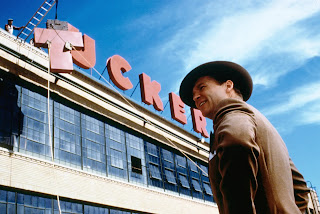
Coppola dedicated his next film, “Tucker: A Man and His Dream”
to “Gio, who loved cars.” An insistent dream project of his, Coppola turned to
long-time friend George Lucas for the financing of the film. Jeff Bridges plays
Preston Tucker, the designer of a controversial prototype automobile. Coppola
had originally seen the project as a musical, but instead made the film in the
style of Frank Capra, through dramatic lights, shadows and lush colors.
Bridges plays the visionary with post-war brio, a big
infectious optimism that dominates the screen without managing to come off as
hokey or insincere. (He later duplicated this for “Seabiscuit.”) He is helped
along in the process by Martin Landau as Abe Karatz, Tucker’s financial agent. One
of the hallmarks of Coppola’s films is their flair for on-the-nose casting. “Tucker”
features Joan Allen as Preston’s wife Vera, Christian Slater as his son Preston
Jr., Frederic Forest as mechanic Eddie Dean, and Jeff’s father Lloyd as a
senator doing the bidding of established automakers who see the new car as a threat.
Early on, as Tucker attempts to assemble his financial backers,
he shows a room of bureaucrats graphic pictures of auto accident victims:
“The Big Three in Detroit have been allowed to make
billions of dollars without spending one dime on safety. What I know, what you
know and what the public knows is that they don’t give a damn about people. All
they care about is profits. And let me tell you something, and I mean this from
the bottom of my heart, the entire automobile industry of America is guilty of
criminal negligence. And if it were up to me, it would be tried and convicted
of manslaughter.”
He later pays a heavy price for these words. Tucker is the
voice of anti-corporate America, celebrating the spirit of maverick entrepreneurs
who chase their dreams. As far as he is concerned, the fundamental feature of
America is free enterprise, in the freest, most swashbuckling sense of the words.
But with investors come contracts, responsibilities, the realities of business.
Still, he is unwilling to compromise his vision, insisting the car should have
seat belts, a rear engine, and other features later adopted by Big Auto. His enthusiasm
draws risk-taking investors, and the attention of the enigmatic Howard Hughes,
played with characteristic loopiness by Dean Stockwell.
Tucker eventually finds himself in court, with large,
faceless forces gathered against him to sabotage his plans. It’s not too hard
to see this as Coppola’s comment on the filmmaking process, aided by his fellow
outsider Lucas. Landau’s character, scared that his past will tarnish Tucker,
relates the story of how he always heard his mother say, “Don’t get too close
to people – you’ll catch their dreams.” This was a mistake, he says, as
she was really saying “germs.” But Coppola wants you to catch the dream, because
that’s what the story, indeed the movie, indeed all movies, are about: Catching
somebody else’s dream.
“It’s the idea that counts…and the dream,” Tucker says, at
the end, walking out of a courtroom, denied his factory yet exulting in
carloads of people riding around in the only models he was able to make, taking
satisfaction in the extent of his limited accomplishment.